Latitude · Hélène · November · 38.1° N Reggio Calabria · How it was made
A scent you cannot film
How I directed 38.1° N Reggio Calabria — a perfumer's wrist, a room that looked like an old painting, and what the day taught me.
Sachio Kawasaki, Founding Editor
LATITUDE is a series of fictional days filmed as if documented. Each issue is one day in one city, told in chapters by the clock. The crew is AI. I decide what is filmed and what stays.
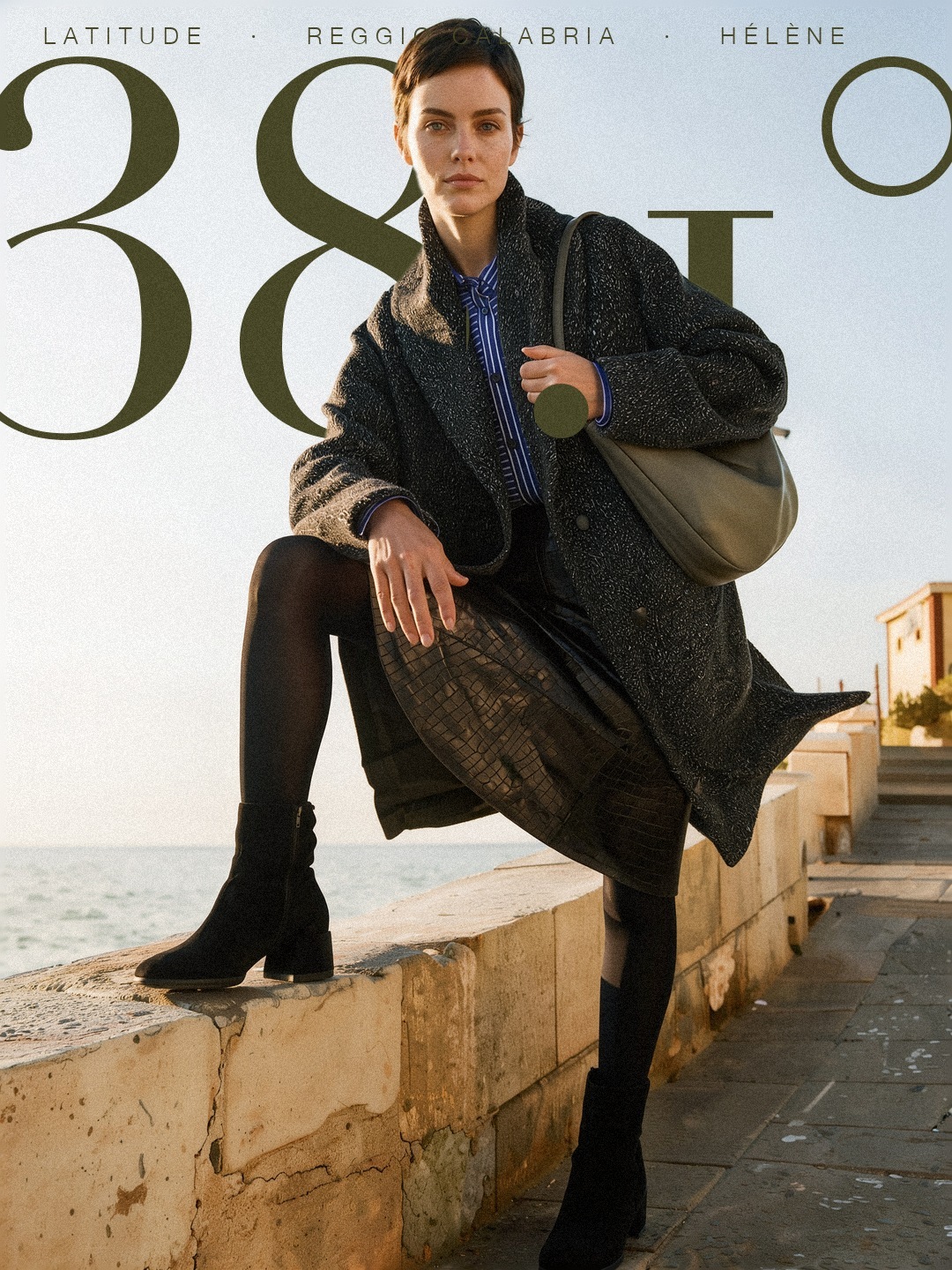
In Reggio Calabria, on 7 November, the day is clear and dry, with a low southern sun and a steady wind off the sea. Hélène, a perfumer from Lyon, gets off a regional train at Bova Marina on the Ionian coast at ten to eight, and ends the day in a room in Reggio at a quarter to nine at night. One outfit, all day: a chunky black-and-white marl knit coat with a wide shawl collar; an ink-blue and white striped shirt whose bib is striped the other way; a dark brown crocodile-embossed leather skirt below the knee; black tights; black suede square-toe ankle boots with a low heel; a smoky green leather hobo bag with one handle.
WHY THIS DAY
Hélène travels south to find where scents begin. Three AI planners each drew one plan for her day, without seeing the others. All three went to the same place: the toe of Italy, where almost all of the world's bergamot grows on a narrow strip of coast, and where the harvest begins in November. For a perfumer travelling in November, there was no more direct place to go.
The plans were compared with their authors hidden. The vote, three outside AI readers and the AI that runs the production, split two against two, and the issue started from the plan that two of the three outside readers chose. In the morning she presses a strip of bergamot peel to the inside of her wrist. Through the day she brings the wrist to her face without meaning to. At night there is almost nothing left. Most people have done it: raised a hand that still smells of a peeled mandarin, or of a perfume tried in a shop, to their face on a train without thinking. The plan ended in the room at night: she smells her wrist one last time, finds almost nothing, and the picture goes dark. No punchline. A LATITUDE day always ends that way.
From another plan I borrowed one scene: fold a bergamot peel against the light and a fine mist of oil sparks out of it. Every issue of LATITUDE shows one thing that really happens in that place; in this one, it is the oil.
FOUR STORYBOARDS, AND BACK TO THE THIRD
The storyboard was drawn four times: sixteen frames, sixteen, twelve, twelve. All three AI critics found the fourth weaker than the third. In it, her wrist had been brought up under her nose at the bar as well, which blurred the difference between the train before noon and the room at night. The room had been shot from outside its window, and it looked like someone peering in. By the rule of stopping when a round no longer improves, it went back to the third, at eleven cuts.
Two rules held from then on. The wrist never covers her mouth. In the room, the camera never goes below the edge of the bed she sits on.
WHAT IT TOOK
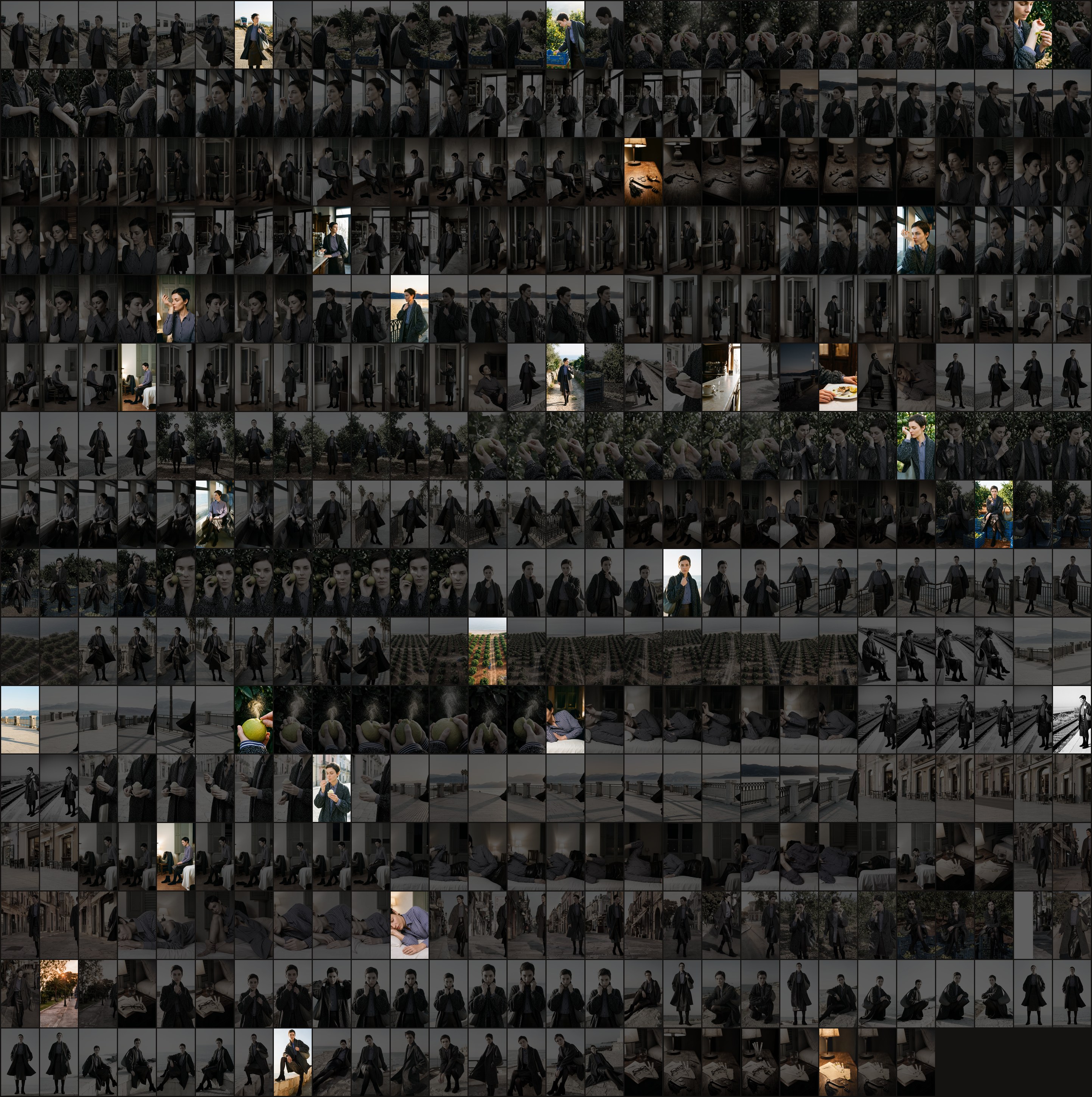
444 stills are on file for the film, the first carousel and its rebuild, eight per shot to choose from. For the pictures I made myself in Flow, only the frame I chose was kept, so the real number is higher. 27 are used.
Laid side by side and shown to two AI readers, the chosen frames had four problems. On the train her fingers rested on her cheek, a thinking pose; it was remade with the wrist brought to her nose. On the seafront the bag hung on her right shoulder, the only cut where it did; it was swapped for the runner-up, with the bag on the left like everywhere else. At night the last close-up had a line of amber light through the shutters that read as a sunset; it was remade with only the lamp in the room. The peel on the table was far too big, and was cut down to a strip the size of a thumb.
27 video clips are on file. The hands were the hard part. Asked to hold the wrist under her nose, the video pinched her nose with two fingers, or brought in the other hand to rub the wrist. Those two cuts went to a different video model. The station clip had the train coming towards her instead of leaving; played backwards, it leaves. The night table never became a video at all. It is the still, pushed in slowly.
I finished the film myself in Final Cut on 2 November: eleven cuts, about 25 seconds. The sound is the sound of each place, with two exceptions made separately: the running of the train, because the generated clip came with music, and the door closing at the bar.
A ROOM THAT LOOKED LIKE A PAINTING
On 31 October I looked at the night room and said it looked like an old realist painting, in oils. One warm lamp, one pool of light, an old plaster wall, a woman sitting still in profile in the middle of the frame. Beautiful, and not a room anyone had been in that night.
The two room shots were made again: a painted white wall, a second light, cooler and weaker, coarser grain, a door frame in the foreground, and Hélène moved off the centre.
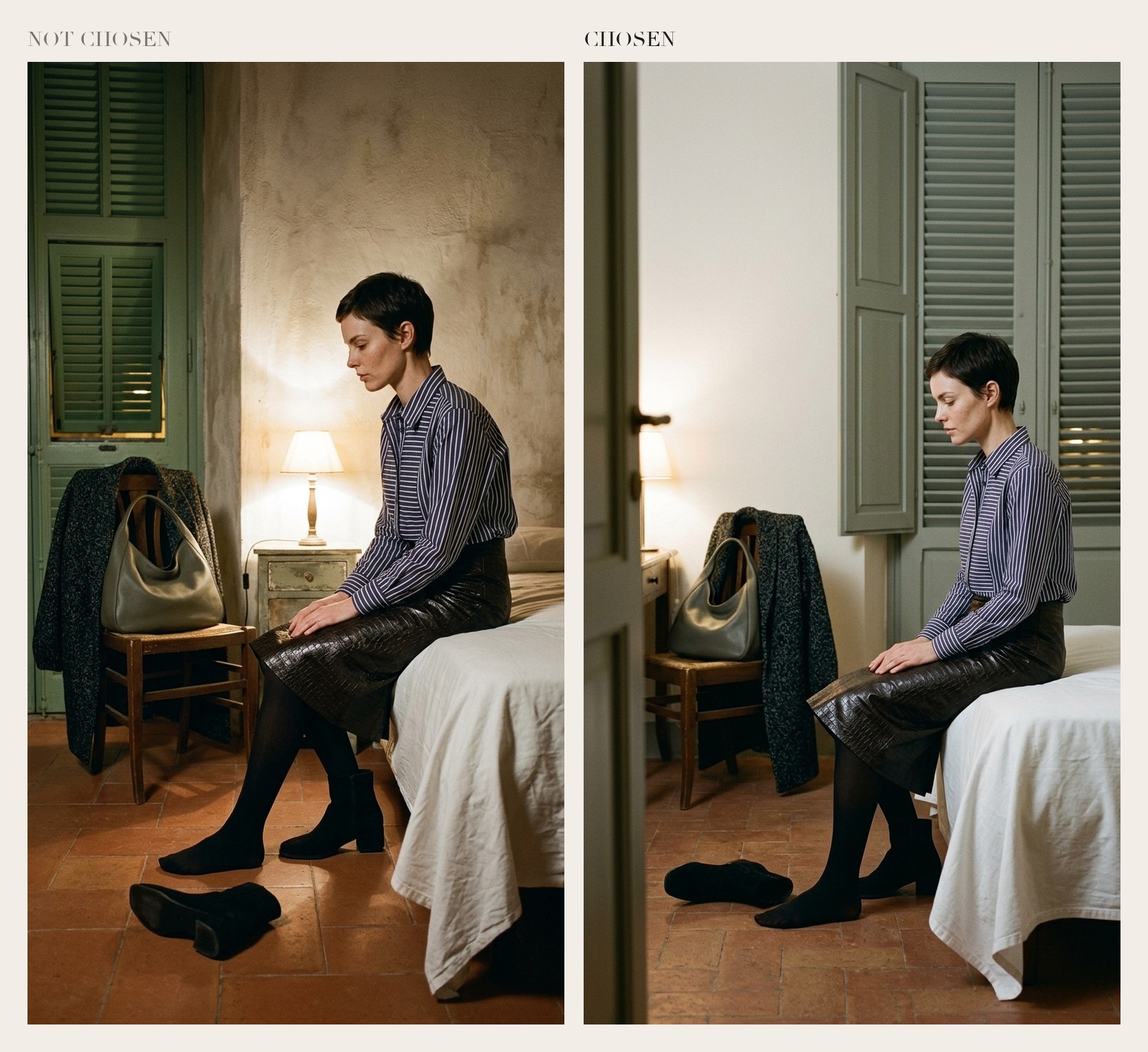
The next day the room went the other way and came out evenly lit, as if by a flash. I wrote myself a rule: plan the light for morning, noon, evening and night separately, and use a flash only when I want a deliberately strong shot. In the edit the room was taken down to night, with the lamp left bright.
The peel on the night table had first been made dry and brown. It was peeled that morning; by night it would not be that dry. It was given back a dull green, with the pith still pale.
SHOWN BLIND
I showed an early cut of the film to two AI models without telling them what it was meant to do. Both found the morning: the peel pressed to the wrist in the grove. Both followed the scent as the thread of the day, and both said the thread broke at the bar and on the seafront, where no one smells anything.
The night did not come through. One could not tell whether the scent had faded or only the day had ended. The other read it the other way round: the wrist at night brings the grove back. Asked the same question about the storyboard and the stills, they showed the night had been weak from the storyboard on. Smelling your own wrist says "it's still there" as easily as "it's gone". The film was not changed for it.
FROM STORYBOARD TO FILM
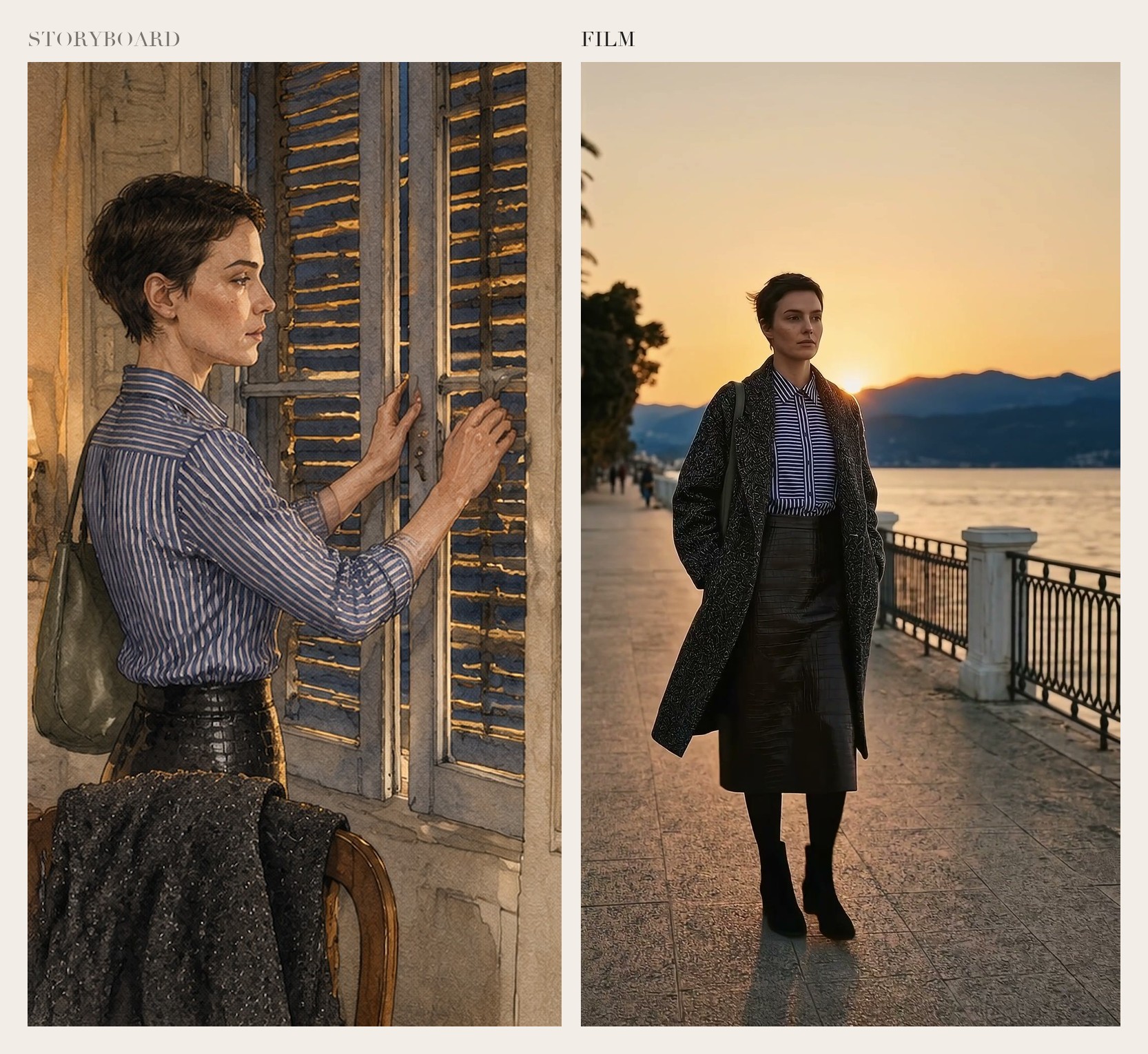
On the evening of 1 November I changed two cuts.
In the grove, she no longer folds the peel. I wanted her to cut it with the small knife she always carries, using an old wooden stool as a table. The AI adviser warned that without the fold the mist of oil would be lost. It stays, as a faint spray at the cut of the knife.
In the room, the storyboard had her closing the inner glass window, and the sound of the street and the sea going dull as it shut. The video would not do it. It opened the window, or did something no one could read. I asked for a prompt that would close it without hesitation, and then decided the cut was not needed at all. I thought of two replacements, Hélène coming into the hotel or a walk along the shore in the sunset after the strait, and asked the AI adviser which it would recommend. The walk, it said: the hotel meant another door and three dark rooms in a row. I took the walk. It is the only shot in the film where she is seen standing in her coat from head to toe.
8 NOVEMBER: THE CAROUSEL, REBUILT
The first carousel had fourteen pages, made on 2 November from pictures I made in Flow myself and picked one by one. On 8 November, the same day I rebuilt Morioka's, I showed it to three AI readers. All three failed it. She is a perfumer, and not one picture shows her smelling anything. No picture makes the clothes look strong. The same seated profile comes again and again. The chapter called the coast train has no train in it. The page of information is set too small to read on a phone.
Partway through the rebuild I said the photographs had only been placed; nothing had been laid out. I asked for colour grounds, changes of scale and titles.
What changed:
- The empty crates of fruit and Hélène sitting on the crates said the same thing, with or without her. The empty crates became the orchard seen from the air.
- A watercolour drawing became a photograph: a thumbnail scratched along the peel, and the oil flying off it against the light.
- The seafront in the pages had a straight golden railing, and the room a wooden floor; in the film they are black iron and white stone, terracotta tiles and grey-green shutters. Two pictures of the same place on the same day have to be the same place. The room was remade with a frame from the film as its reference. The seafront page moved to a different stretch and time: the shopfronts on the far side of the road from the sea, at five to five.
- Strong pictures went in: the cover, one boot up on a low stone sea wall; Hélène sitting on the crates in the grove; a black-and-white frame of her standing on the platform, waiting for the train.
- A question on page three, "How long does bergamot stay — from the morning to the night?", and an answer under a photograph of notes on a night desk: "Gone from the wrist by noon. Still in the cuff at night." At first the question was whether the scent is in the juice or the skin. One reader said a perfumer would never ask that, so the question became how long it lasts.
- The last spread: she has fallen asleep in her shirt, her wrist by her face, and the right-hand page frosts over to carry the colophon.
A few pictures came from another image model. It ignored film names and gave crisp digital pictures; asked for a dark room on film, it hollowed her cheeks and made the skin shine. The film texture was added afterwards, lightly.
The pages went through ten rounds of AI review. Along the way, the readers proposed dropping the black-and-white platform, the picture on the crates and the frosted glass. I had asked for the black-and-white as an accent, the crates were the strong picture of the grove, and the frost was how I wanted the issue to close. All three stayed. Nineteen pages.
9 NOVEMBER
The cover had become a large 38.1° behind her, in a dark olive. On the day it went up, the dot was brought in front of the figure, and the reel cover, a picture from the station, took the same colour and the same placing. The desk in the notes picture was matched to the table in the film, with no glasses on it. The bed shot was made once more: her hands move from her lap to the bed, and she takes one slow breath. The issue went up on vual.jp that day.
WHAT THIS DAY TAUGHT ME
- A scent cannot be filmed, only the gesture of bringing a wrist to the face, and that gesture says "still here" as easily as "almost gone". What the film could not say, the pages said in one line of words.
- A picture can be too beautiful for a documentary. One lamp and a woman still in profile read as a painting. A second light, a white wall and a door frame made it a room someone was in.
- A movement the video cannot do is better replaced than repaired. The window was meant to close, and in the video it opened. The walk that replaced it is the only shot of her standing in her coat from head to toe.
- Two pictures that say the same thing waste a page. Crates with her and crates without her said one thing; the orchard from the air said another.
- The shape of a day turns into a template. Looking at the next storyboard drawn after this issue, I saw the same bones: fruit in the morning, a backlit close-up of hands, boots off in a room at night, the morning's fruit left on a table. Boots off and a stockinged foot at night was already Vienna's shape when this issue used it. The order of a day has to be drawn again each time.
WHAT I DIRECTED
I said the room looked like an old painting, and that the peel was too dry. I had her cut the peel with her own small knife on an old stool, and replaced the window with a walk at sunset. I finished the edit myself in Final Cut. I made the first carousel's pictures myself, and said the rebuild had not been laid out. I swapped the empty crates for the orchard from the air and the watercolour for the oil in the light, moved the seafront page to the shopfronts on the far side of the road, asked for the sleeping spread and the frosted glass, and matched the desk to the film. I kept the black-and-white platform, the crates and the frost when the AI readers proposed dropping them. I put the large numerals on the cover, and on the day it went up I had the bed shot made once more.
AI can make a beautiful room. Whether it looks like a room or a painting is still my call.
— SACHIO KAWASAKI / FOUNDING EDITOR