Latitude · Rin · November · 36.6° N Kanazawa · How it was made
When the hood comes down
How I directed 36.6° N Kanazawa — how to film rain stopping, and what the day taught me.
Sachio Kawasaki, Founding Editor
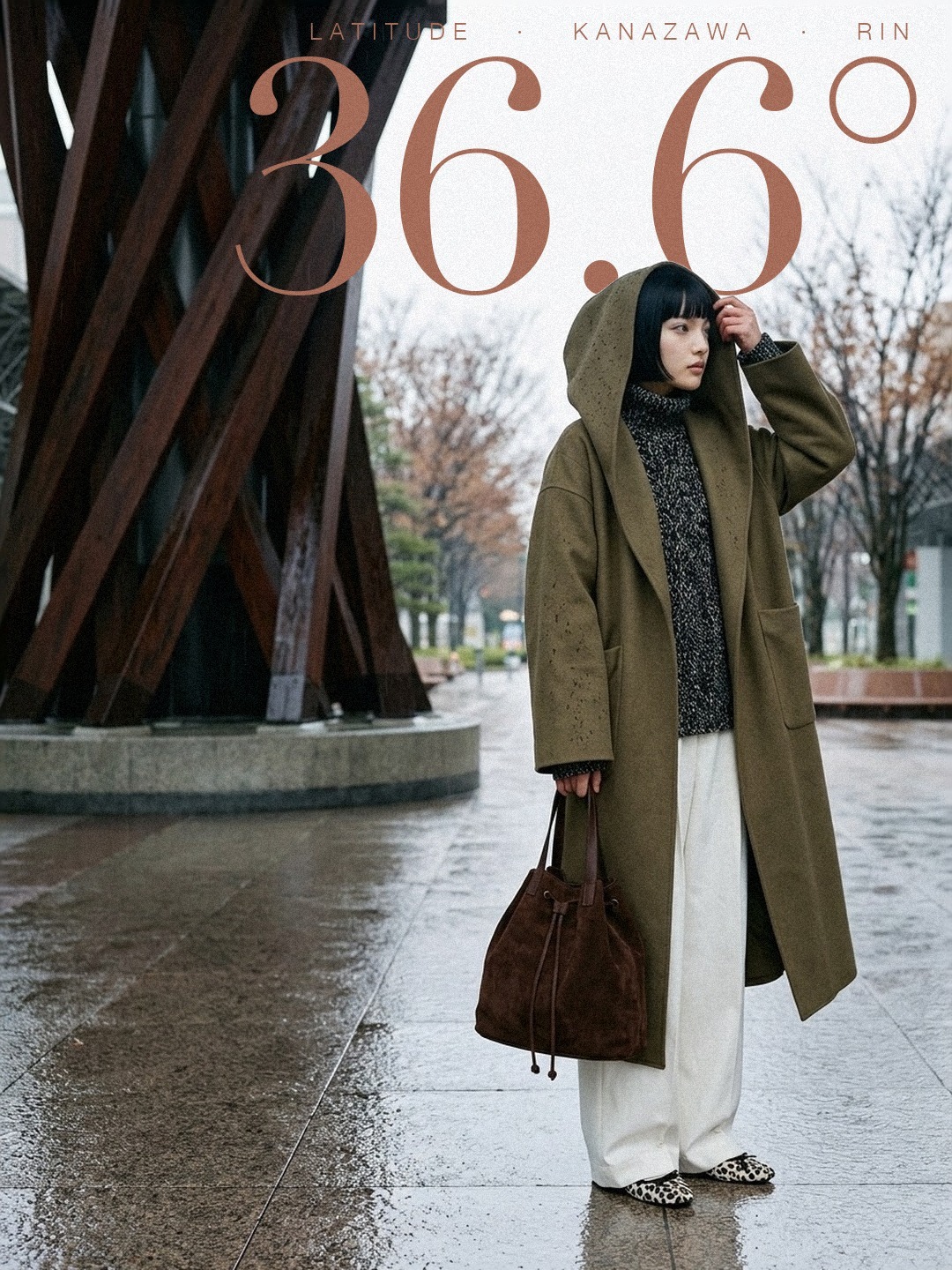
LATITUDE is a series of fictional days filmed as if documented. Each issue is one day in one city, told in chapters by the clock. The crew is AI. I decide what is filmed and what stays.
In Kanazawa, Rin arrives on the morning train in late November and ends the day at an inn by the Asano river. One outfit, all day: a long olive double-faced coat with a hood; a black-and-ecru turtleneck; long white trousers; leopard-print ballet flats with black socks; a large dark brown suede drawstring bag.
WHY THIS DAY
Kanazawa is LATITUDE's first issue in Asia. I moved the date to late November to match the weight of the clothes. The ending was decided on the day I began: no twist, no change of heart, close on a quiet scene. A twist made on purpose looks staged; a sight the viewer has seen before is one they can put themselves into.
RAIN THAT STOPS
In late November the rain here comes and goes in short, cold showers. They call it shigure. That was the story: it rains, it stops, it rains again, and each time it stops, the town shines.
I drew it as a rough watercolour storyboard of sixteen frames and showed it to three AI critics, revised it and showed it again, five times over. The first version, they said, had too many frames of scenery alone, and the moment the rain stops never ran as one continuous beat. I cut the scenery-only frames, and sixteen frames became ten.
The hardest thing to film was the one the story depends on. Rain falling is easy. Rain stopping is an absence. In the first full cut, a critic said so: the moment it stops is never on screen, and the rings on the water look like rain still falling. Only the sound changed.
The answer was already in the storyboard: make the hood the signal, up when it rains, down when it stops. But in that cut her hood was already down. The next edit shows the moment itself, because a hood coming down is something a camera can see.
- 08:50, under the wooden Tsuzumi-mon gate. The first shower. Hood up.
- 12:30, Omicho. At a lunch counter, coat off, a hot bowl in both hands.
- 16:10, Higashi Chaya, under an old eave. Hood up, waiting.
- A puddle goes still. The hood comes down. She walks into the wet lane.
- 19:30, the inn. A dark room, one paper lamp, her arm on the window sill.
WHAT IT TOOK
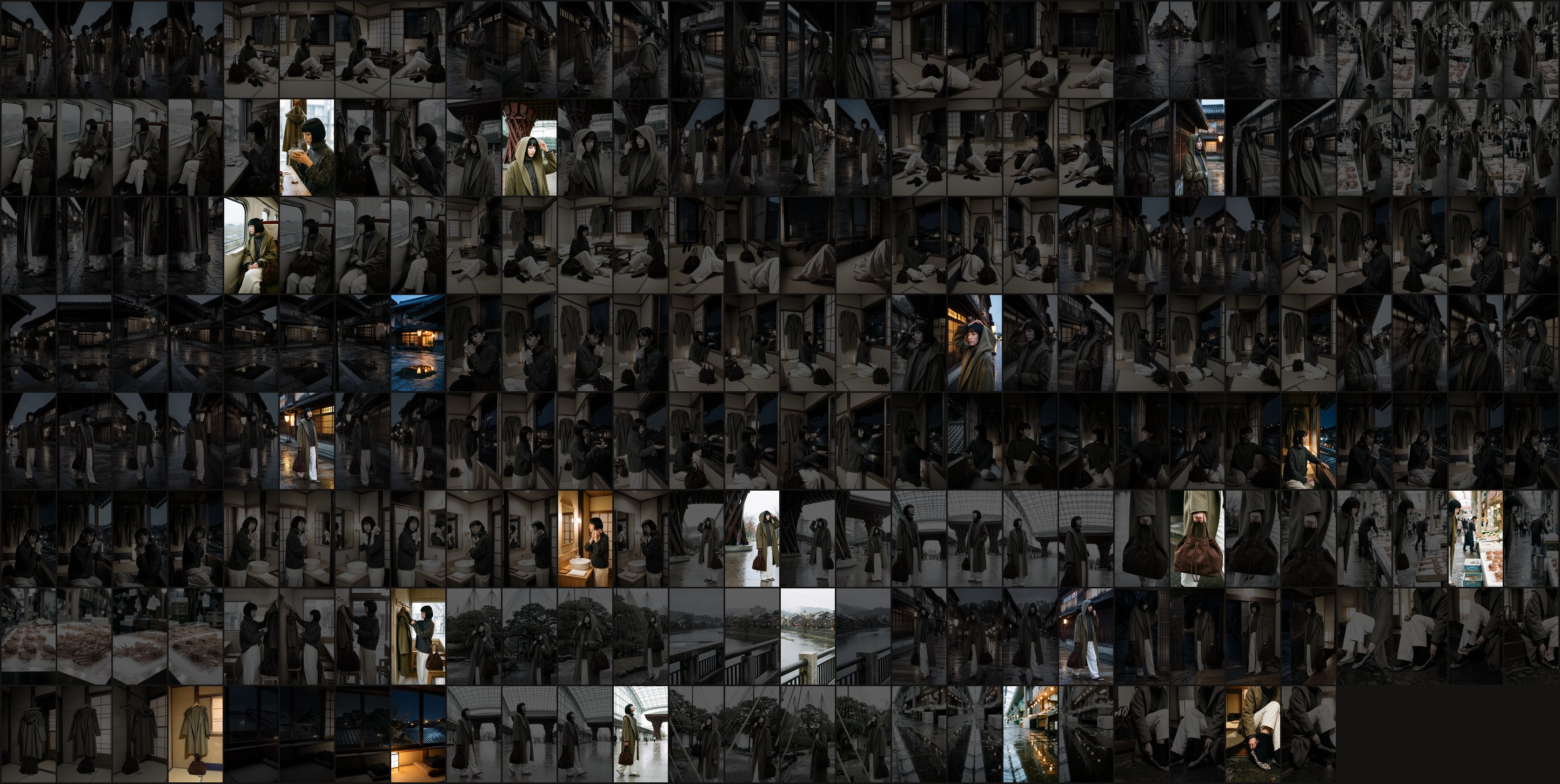
This is the second Kanazawa. The first was a test: I chose the clothes and let the AI crew do the rest without me. It came back finished — three outfits, a house track cut to the beat, 204 stills, 16 clips. Even the final version had been picked by an AI judge comparing cuts. It was competent, and it was not a day: each change of clothes lets the viewer step out of the story. I set two rules — one outfit per day, no music — and started again.
The rain day took 220 stills, 43 video clips and eleven edits. I finished the last pass myself in Final Cut. Nine cuts, 24.5 seconds.
WHAT WENT WRONG
A hand out of the window. For the ending, a critic suggested she hold her palm out to check the rain had stopped. In a blind check, one of the models even named it the best moment. I watched it and saw a B movie. When I said so, all three found the reasons: flat light from nowhere, a gesture held for the camera. Now she just sits by the window, and the prompt says: no hand out of the window, no palm turned up.
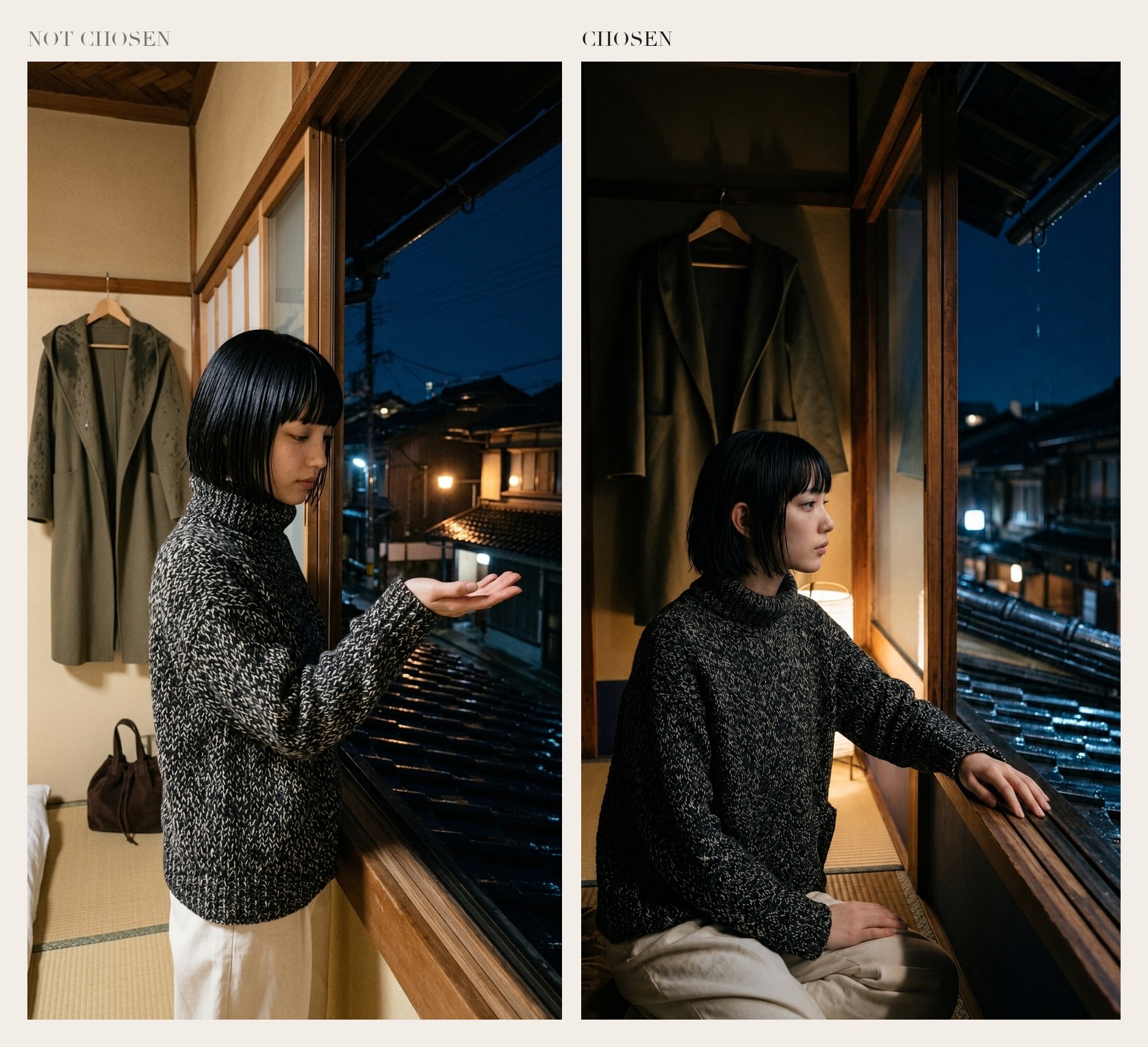
Rain marks cleaned away. A retouch removed the rain marks on her coat as if they were dirt, and the wet coat at the inn no longer matched. Now every cut has a state table — hood up or down, where the coat is wet — and nothing in it gets cleaned.
Shoes on the tatami. The rough storyboard put her flats on the tatami, and later the inn got a Western sash window. In Japan, shoes come off at the door, and windows slide.
WHAT THIS DAY TAUGHT ME
- Let the clothes carry what the camera cannot. Rain stopping is an absence and never showed; a hood coming down is an action, and it did.
- Write down the state of the garment, cut by cut. Wet shoulders were continuity, not a flaw, and the retouch quietly removed them.
- The outfit decides what is possible. I had written water running down her neck; a critic pointed out she wore a turtleneck and a hood. This outfit could show the ear, the jaw, the wet ends of the hair, a wrist at the cuff, and I rewrote the scene for that.
WHAT I DIRECTED
I decided that Kanazawa would be one outfit and no music, and that the version made without me would not be the issue. I decided the open palm was a B movie, that she dries her hair at an ordinary washroom mirror, that the walk runs faster and the sound cuts hard into the quiet scenes. I finished the edit by hand.
AI can make a day that looks finished. Saying it is not a day yet is still the job.
— SACHIO KAWASAKI / FOUNDING EDITOR