Latitude · Solveig · October · 64.1° N Iceland · How it was made
The morning the title became a number
How LATITUDE began with 64.1° N Iceland — a place name that became a coordinate in 34 minutes, and what the day taught me.
Sachio Kawasaki, Founding Editor
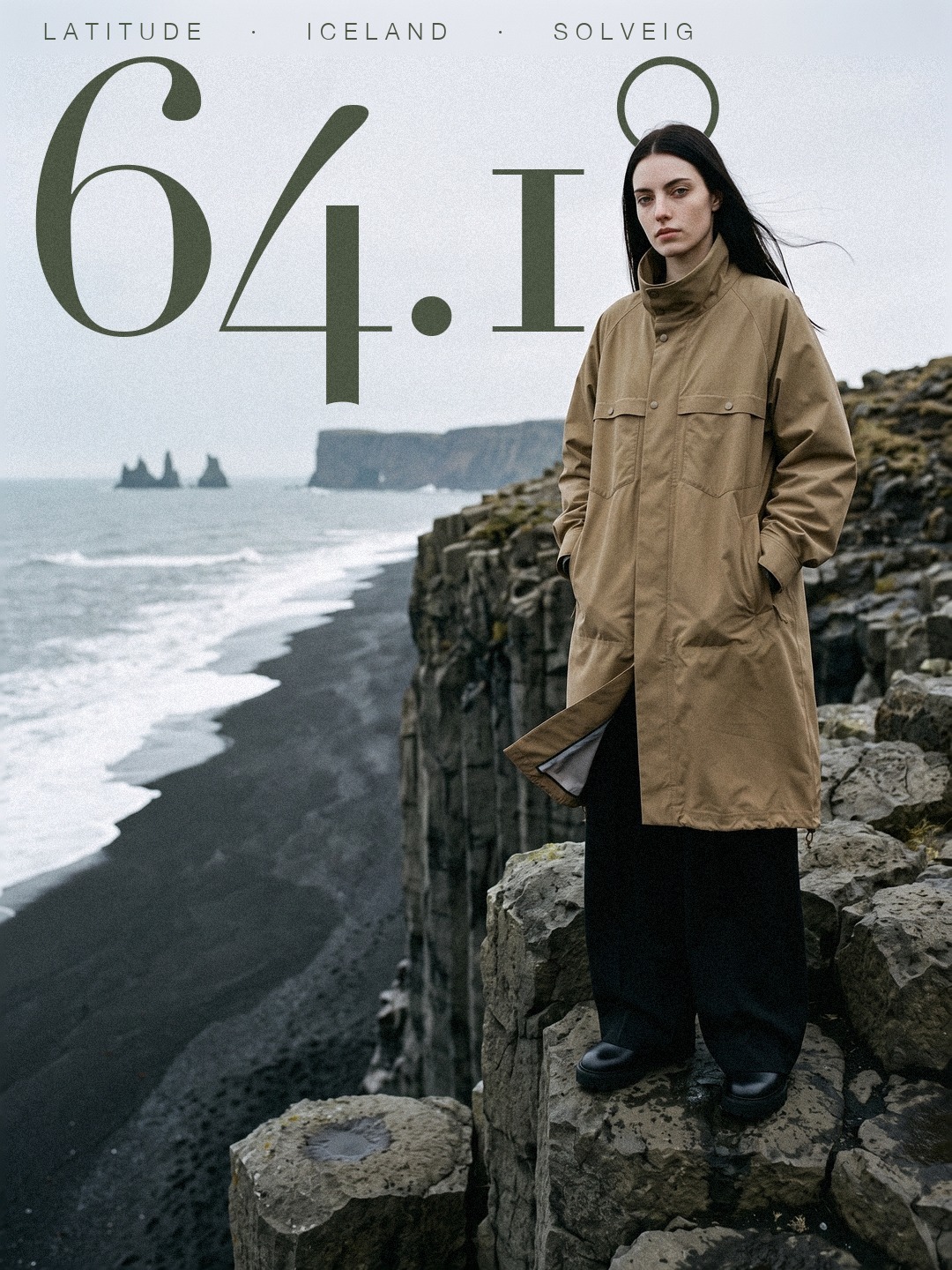
On the morning of 20 October, a title card that said ICELAND was remade three times in 34 minutes and became 64.1° N. That was the morning the series got its name.
LATITUDE is a series of fictional days filmed as if documented. Each issue is one day in one city, told in chapters by the clock. The crew is AI. I decide what is filmed and what stays.
Iceland was the first issue. A woman stands on the black sand at Reynisfjara at 07:40, puts one boot up on a bollard in Reykjavík harbour at 12:15, and stands among the glass walls of Harpa at 17:50. Three coats: khaki-beige, closed up to a tall collar, over very wide black trousers; a navy pea coat with shearling across the chest and shoulders; a collarless camel coat, belted at the sides, over cream wide trousers.
HOW IT BEGAN
The film did not start with a name. On the morning of 20 October I was cutting it, and the title card simply said ICELAND, with the three places in small letters underneath.
At 09:09 the next version took the country off the title and put a coordinate there: 64°N, with ICELAND small below it. In the same version each chapter got the place and the time in the corner of the screen. REYNISFJARA 07:40.
At 09:23 the word LATITUDE appeared above the number, and the number became 64.1° N. On its own, 64 reads like a count. With the word above it, it reads as a line on the globe.
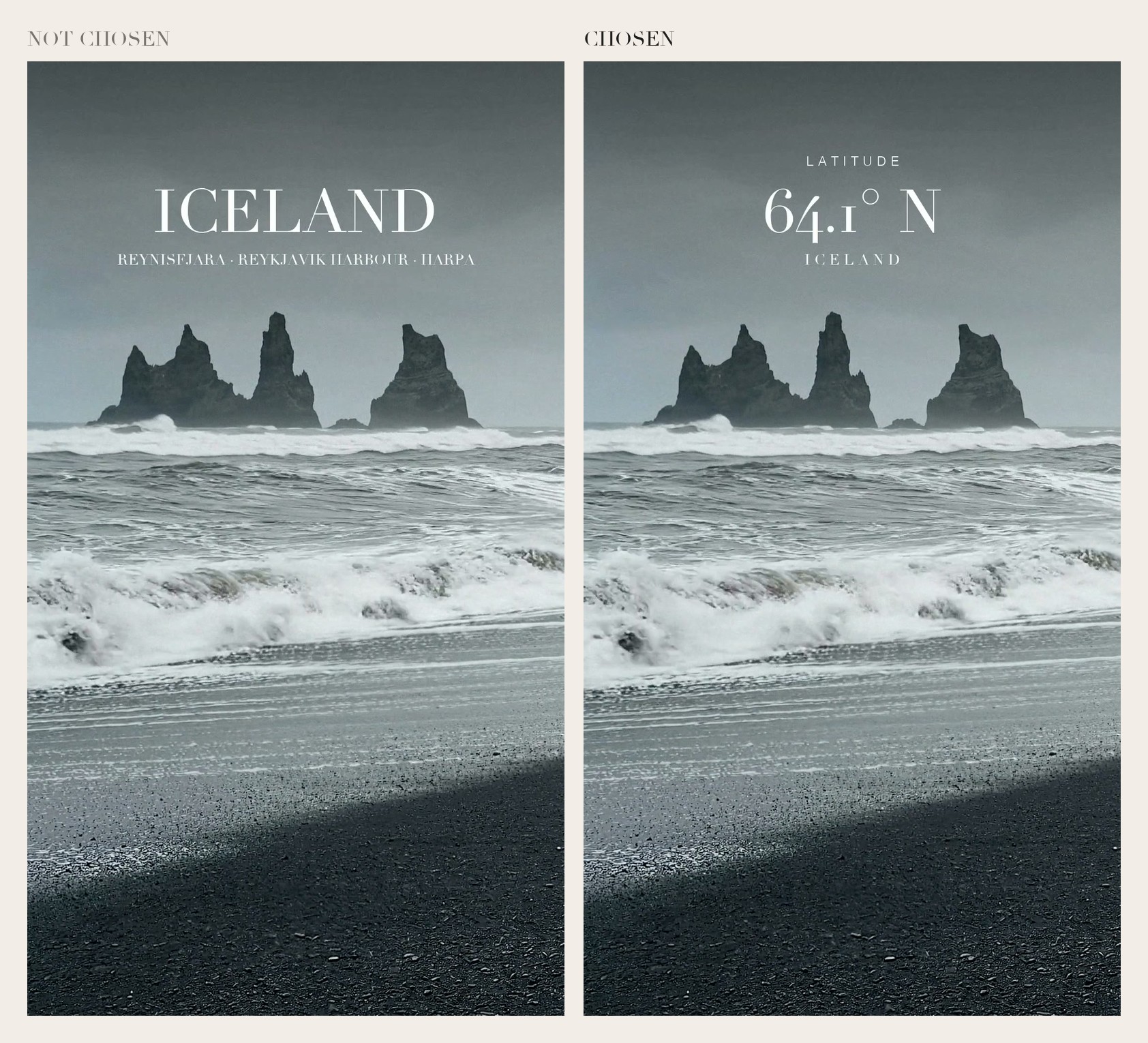
Thirty-four minutes, three title cards, and the series had its name. The caption said it plainly: one day, one place, and someone who belongs there; each film is named after the latitude where it was set. That evening the same title went on the cover of a nine-page magazine issue. The next morning both were on the site.
Two things from that morning have not changed since: the title is a latitude and a city, and the chapters move by the clock.
WHY THIS DAY
The day was built from light and weather: an overcast morning on the black beach and basalt columns of the south coast, a windy noon at the harbour in Reykjavík, dusk against the glass walls of Harpa. As the issue's field notes say, the basalt columns of the morning and the glass of the evening share one shape. On 20 October I decided who would be in it: the traveller is not one person but the camera, and in each city it can be someone who lives there. The film ends on a close-up at dusk, her eyes lowered behind the glass, left running as it goes dark. I decided that day not to swap in another picture for the logo.
WHAT IT TOOK
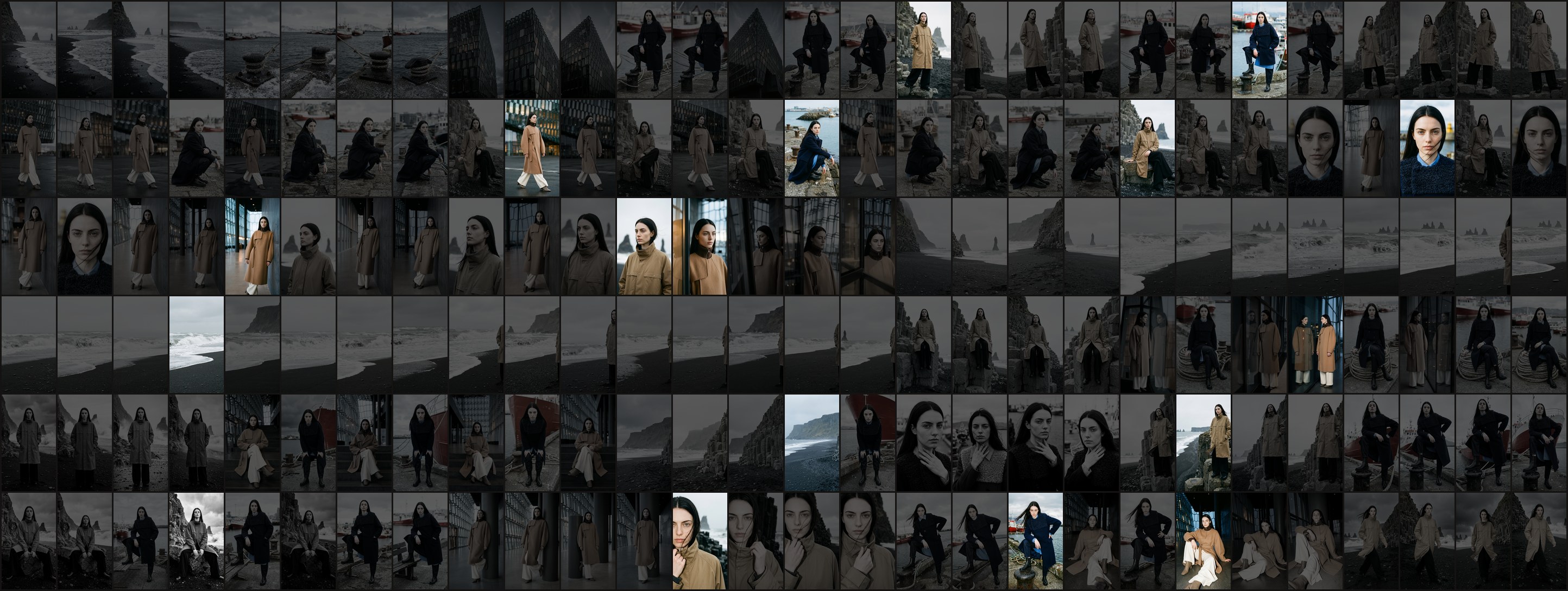
133 photographs of the real places, from a public archive; 12 used, a different one for each shot. 168 still images: 72 upright frames for the film, 28 wide frames for a single sweep across the beach, 68 for the magazine pages. 13 video clips. 20 versions of the edit, between 07:19 and 11:02.
Nine of the 72 upright frames are in the film. It runs 22 seconds.
WHAT WENT WRONG
The sound jumped at the first cut. The film opens on a face from the harbour at noon, then cuts to the beach in the morning. The harbour clip brought its own air, so the film changed rooms one second in. Now the sound of the first place runs from the very first frame.
Some clips arrived with music in them. Video models sometimes add a score nobody asked for. The footsteps at Harpa had music underneath, so they came out. Now every clip is checked for music before its sound is used.
The chapter labels sit too low: on Instagram they fall where the account name is printed. Later issues raised them. Iceland stays as it was posted.
WHAT I CHANGED LATER
Three outfits in one day. Each change of clothes lets the viewer step out of the story, so since 30 October an issue is one day in one outfit. And in Iceland the woman had no name. She has one now: Solveig, from Bergen, who records sound for documentaries.
WHAT THIS DAY TAUGHT ME
- The frame had to come before the content. A coordinate and a clock cost nothing, and they made every new film readable against the last. The clothes, the city and the person could change. The frame did not.
- Each shot needed its own photograph of the real place. One reference for everything gives you the same wall in every frame.
- Sound has to be heard before it is trusted. Some clips carried music or the wrong room. I now check a clip's sound as carefully as its hands.
WHAT I DIRECTED
Every frame carried one line about attitude: she belongs here, and nothing here impresses her. I chose nine frames of 72, and the wide one for the beach. I asked for the film to open on a face, because no one knew the series yet. I moved the sweep across the beach to the end of the morning. For the magazine I had two photographs redrawn five ways each, and ruled out anything pretending to be pencil or watercolour; brush-ink lines and flat colour stayed.
And I took the country off the title and put a latitude there.
A place name as a title looks like every travel film you have already seen. Making the latitude itself the title, the number as the lead, struck me as the more interesting idea. That was the whole reason. A coordinate does not describe a place; it only says where you are standing. That was enough to begin.
— SACHIO KAWASAKI / FOUNDING EDITOR