Latitude · Liv · October · 55.9° N Edinburgh · How it was made
The issue where I took the music out
How I directed 55.9° N Edinburgh — eleven pieces of music tried and dropped, 236 stills, and what the day taught me.
Sachio Kawasaki, Founding Editor
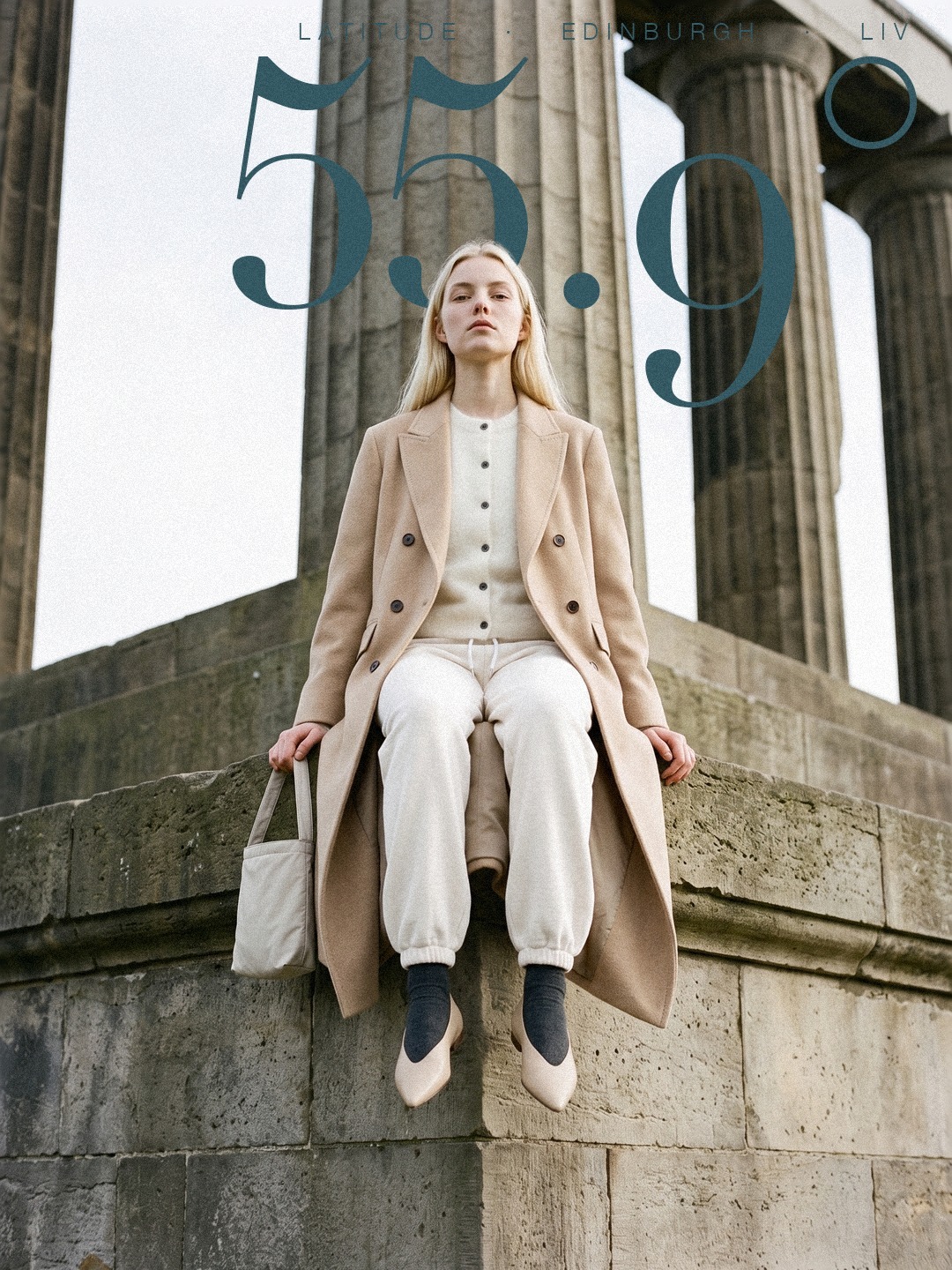
Over three days I tried eleven pieces of music, and in the end took them all out. The 37.5-second film of a day in Edinburgh has no score. What you hear is the place.
LATITUDE is a series of fictional days filmed as if documented. Each issue is one day in one city, told in chapters by the clock. The crew is AI. I decide what is filmed and what stays.
In Edinburgh, Liv, a potter from Gothenburg, comes in on the night train at 07:10 and ends the day in a narrow close in the Old Town at 21:30. In between: the quay at Leith, Calton Hill, Arthur's Seat, and Victoria Street at dusk. In late October the sun there never climbs past 21 degrees, so the whole day is lit from low. She wears four outfits: an olive flight jacket, a pale camel coat, a near-black hunting jacket, and at dusk a golden camel coat over a dark burgundy silk shirt. Flat pointed shoes and charcoal socks all day.
I know the city mostly from the train, passing through on the way north to Perth to fish for salmon.
TAKING THE MUSIC OUT
The first six versions of the edit had a score, like the issues before. The eleven pieces I tried included a dark synth piece with a heavy hit, nu-jazz, a track called Highland Shadow. Each one told you how to feel about the city before you had seen it. The synth was too strong. The jazz did not belong in those stone streets.
At version 7 I took the music out. For versions 18 to 20 I tried music once more. From version 21 on, there is none.
Without a score, more has to be decided:
- A place keeps one sound. While the day stays on the hill, the wind runs under every cut as one piece, so the place does not restart each second. Indoors — the train, the pub at lunch, the whisky bar — the sound lives only inside its own cut.
- Cuts are timed in seconds, not beats. On a beat grid every shot comes out much the same length. Without one, the walk on the quay gets 2.2 seconds, a close-up 1.8, a stretch between the columns 0.9, the last shot 2.8.
Around the same time I added the hours between the chapters: the night train, lunch, a whisky bar, the close at night.
WHY THIS DAY
The first version only showed four outfits in four places. Once it was moving, I could see what was missing: all figure and no room around her, and too little sense of time passing. On 22 October I added the hours between the chapters described above, and empty pictures from the air, the hill and the water. That is when the film became a day. On 20 October I had decided who travels: not one character but the camera, with whoever lives in each city. Liv's name and life came later, on 30 October. And the magazine ends on a photograph of the close at night because on 21 October I took out the itinerary and the credits page, and decided to close there.
WHAT IT TOOK
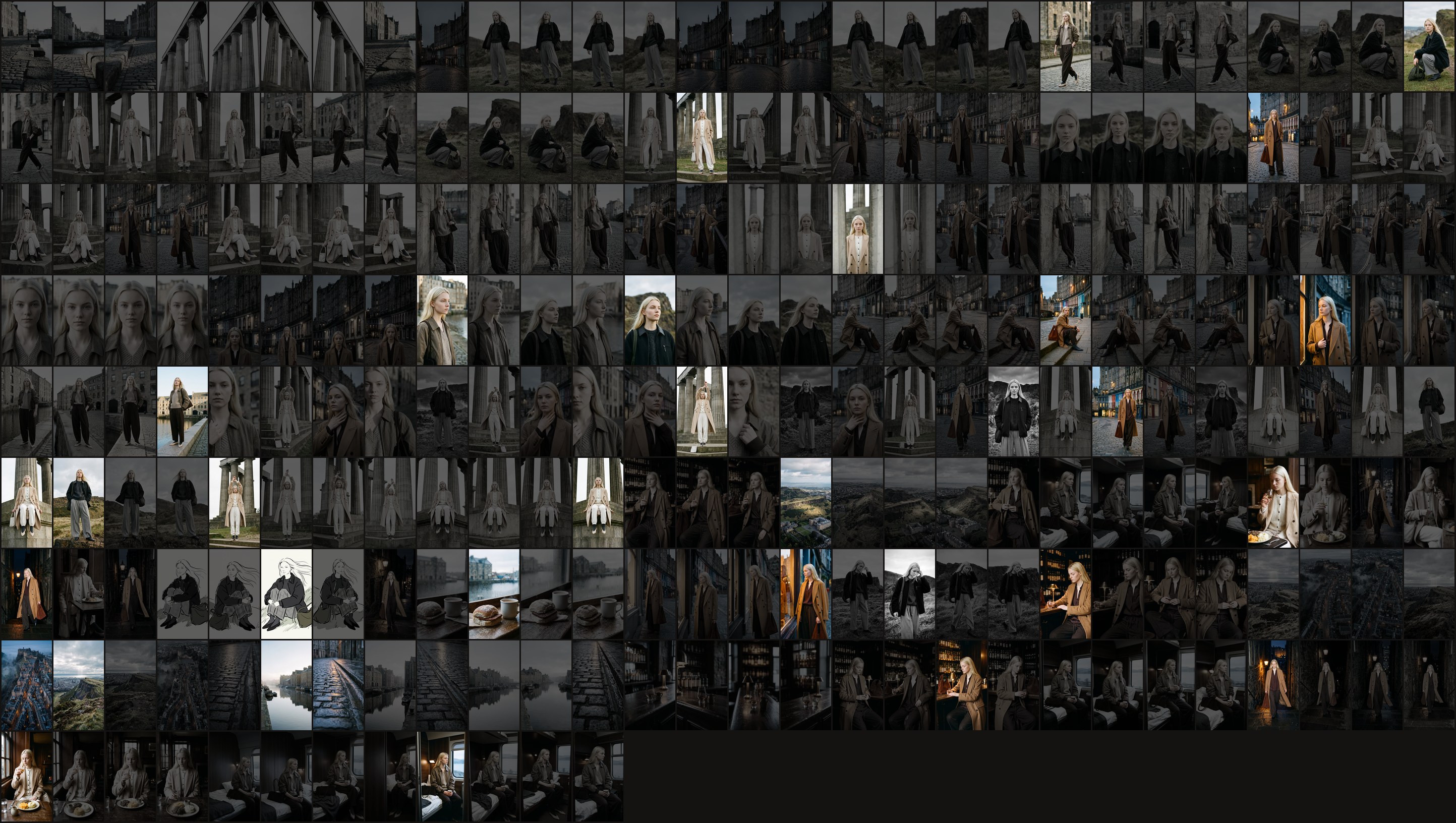
236 still images. 24 video clips. 30 versions of the edit in four days, 20 to 23 October. The finished film runs 37.5 seconds and uses 19 of the 24 clips.
Making the pictures was the cheap part. Deciding how long each one stays on screen was not.
WHAT WENT WRONG
The video model brought its own music. Run through a music detector, 11 of the 24 clips had a score I never asked for. The sound comes attached to the picture, so every clip is now checked before its sound is used. Those cuts took their sound from a clean clip of the same place, or from a sound made separately.
Water under the walks. Leith is a quay, so I first laid the sound of water under her walk. It sounded right in theory and wrong on screen. The walk got the sound of the street instead.
Four changes of clothes in one day. Looking back, this is what I would change. Each new outfit pulls the viewer out of the day. Since the end of October, one film is one day in one outfit.
WHAT THIS DAY TAUGHT ME
Three things came out of this issue.
- Cutting the music showed me what the pictures could do. A score decides how people feel before they have looked at the clothes. If the film holds with only the sound of the place, the pictures are doing the work.
- What is in the frame decides how long it stays. A walk needed longer than a glance. Cut everything to the beat and every look lasts the same.
- Generated video has to be checked by ear as carefully as by eye. In Edinburgh, almost half the clips came with music.
WHAT I DIRECTED
I decided the route of the day, from the quay at Leith to a close in the Old Town, and the twelve stills that became the main clips, chosen on 19 October before the edit began.
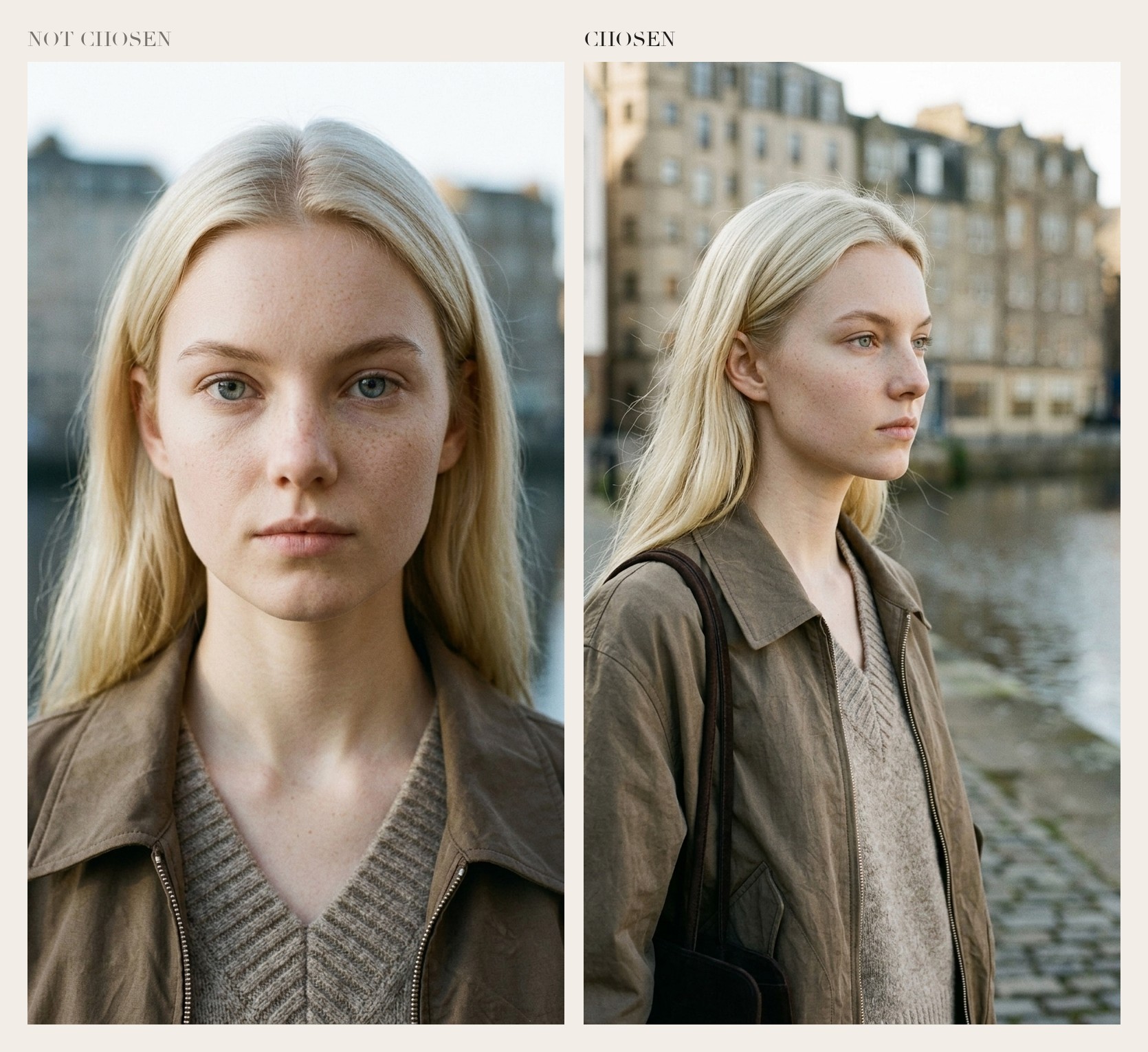
Then: that the music goes; that a place keeps one sound; and that the film ends not on a pose but by a lit shop window, one hand holding her coat closed, half her face in window light, half in blue dusk.
That is the job: not making the pictures, but knowing which ones the day needs — and, in Edinburgh, what it should sound like.
— SACHIO KAWASAKI / FOUNDING EDITOR