Latitude · Solveig · November · 57.9° N Fårö · How it was made
The island where the sun sets before four
How I directed 57.9° N Fårö — a day written inside 8 hours and 44 minutes of light, 349 stills, and what the day taught me.
Sachio Kawasaki, Founding Editor
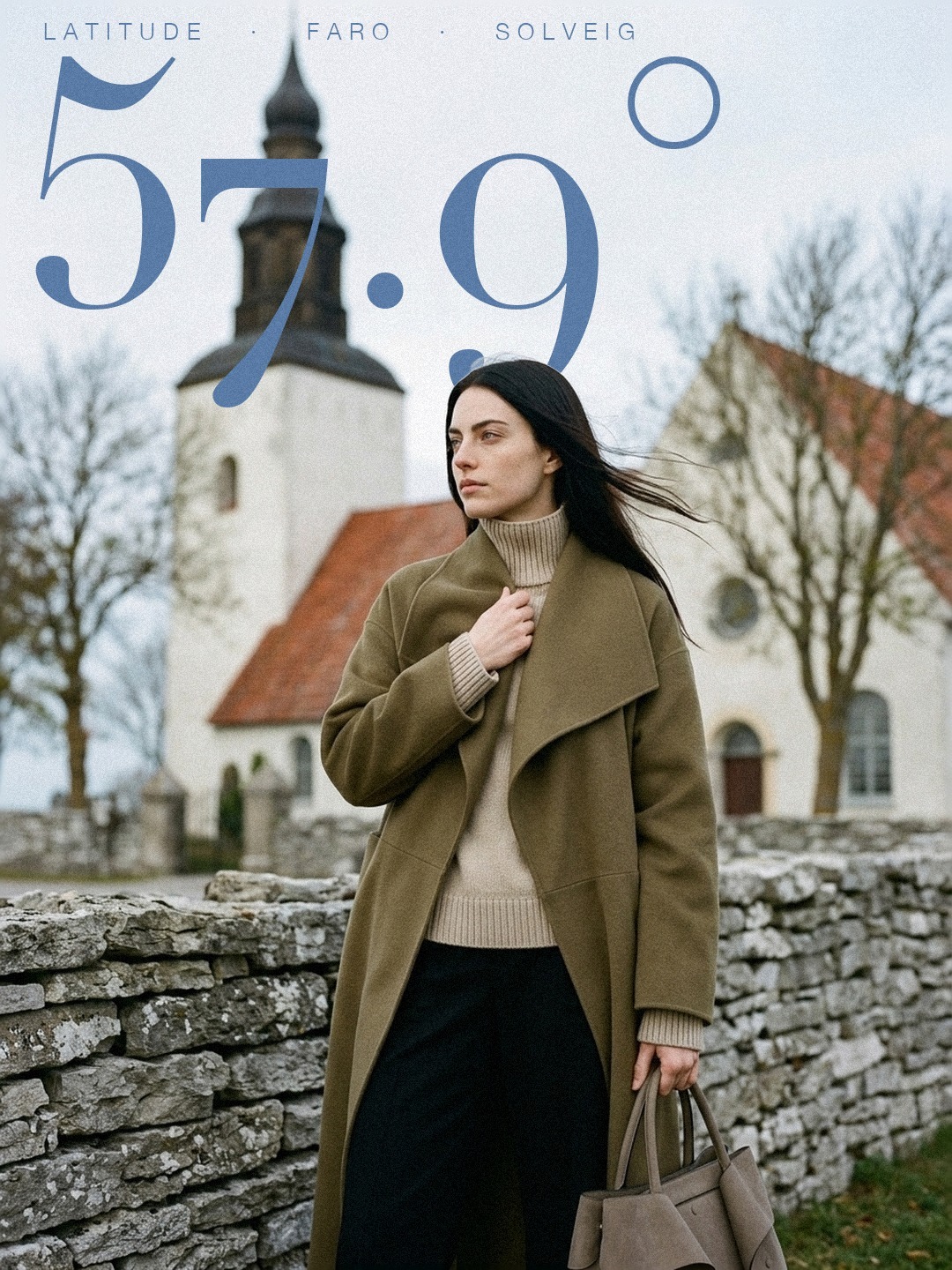
LATITUDE is a series of fictional days filmed as if documented. Each issue is one day in one city, told in chapters by the clock. The crew is AI. I decide what is filmed and what stays.
Fårö lies off the northern tip of Gotland, six minutes by a free ferry. The day: the ferry at 08:40, the limestone stacks at Langhammars at 10:15, the white church at 12:40, the lighthouse point at Holmudden at 15:35, the fishermen's huts at Helgumannen at 16:20 — then a stove. Three coats: dark brown leather lined with shearling; long olive double-faced wool; and, at dusk, curly dark shearling worn fleece-out over an ecru cable knit.
WHY THIS DAY
The woman on Fårö is the same woman as in the first issue, Iceland. I had decided to rotate the models so that the same person comes back and can be met again; this issue was put together the day after. Each of them visits two places in one country, and Fårö is her first in Sweden. The day opens with arriving on the island by the morning ferry and closes on a night scene. Both were forms I had settled in the issue before.
THE LIGHT CAME FIRST
The plan's outline of the day opens with the sun: early November, sunrise before eight, sunset around four. The magazine's light page later worked it out for Fårö church on 5 November: 07:05 to 15:49. Eight hours and forty-four minutes, and at noon the sun stays under 17 degrees.
So the light had to be written, hour by hour. Each scene got a line for its hour; these are the five that run through the day:
- Morning: a low, cold sun from one side, long pale shadows.
- Midday: grey-white overcast, soft and even.
- Late afternoon: the sun very low, amber from the side, the rest of the sky cold blue.
- Just after sunset: an orange band on the horizon, violet-blue above.
- Night in the hut: only a wood stove and one oil lamp.
The chapters sit on those hours. Holmudden at 15:35 is the last quarter of an hour of sun. Helgumannen at 16:20 is half an hour after it. The last eight seconds of the film are lit by fire.
WHAT IT TOOK
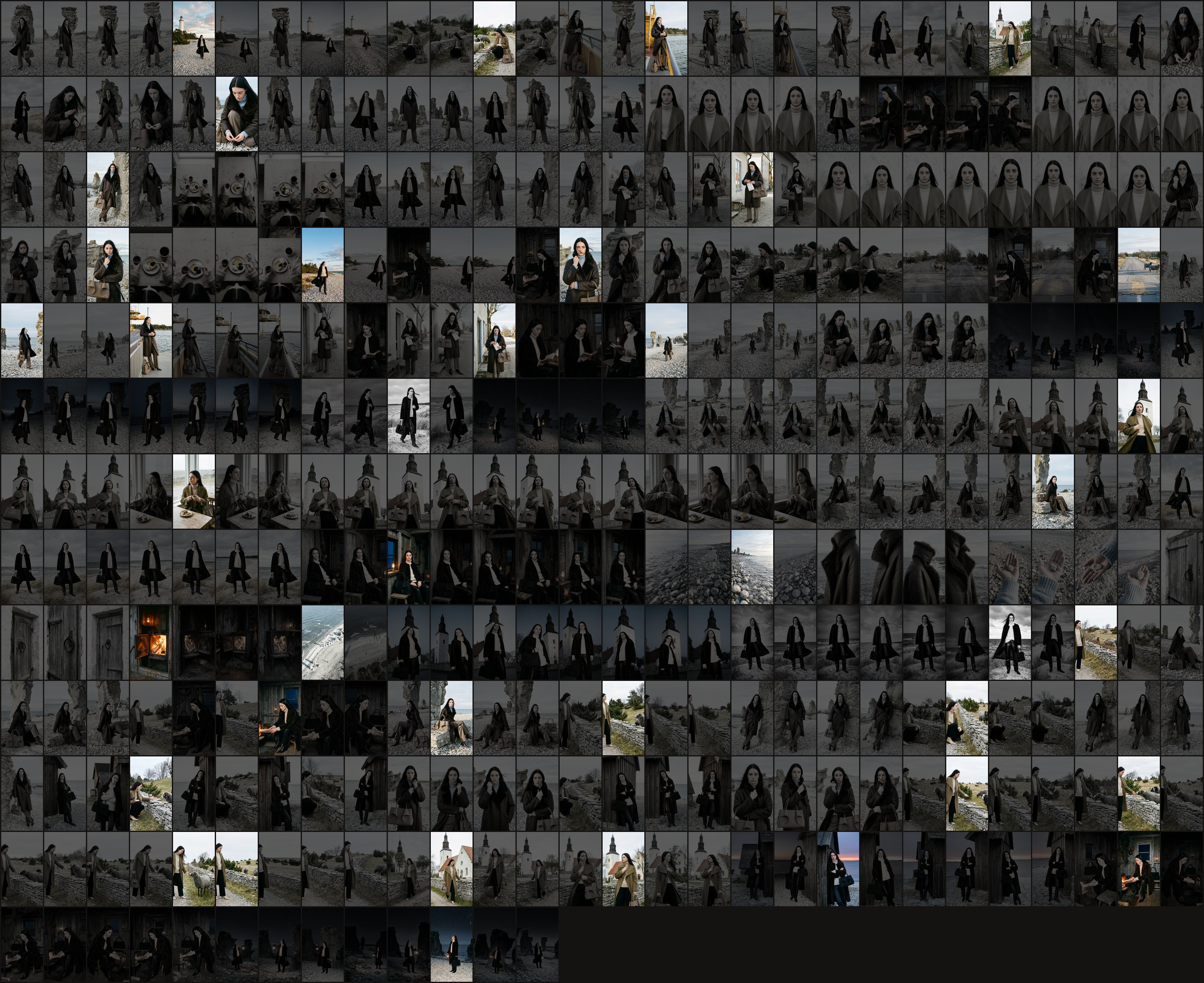
94 photographs of the real places, from a public archive; 28 used as references. 349 still images. 19 video clips, 18 in the film. 24 versions of the edit, 07:16 to 11:00 on 26 October. The film runs 33.5 seconds; the magazine has 20 pages.
39 of the 349 stills were used: 18 in the film, one for its cover, 22 in the magazine, two of them in both.
WHAT WENT WRONG
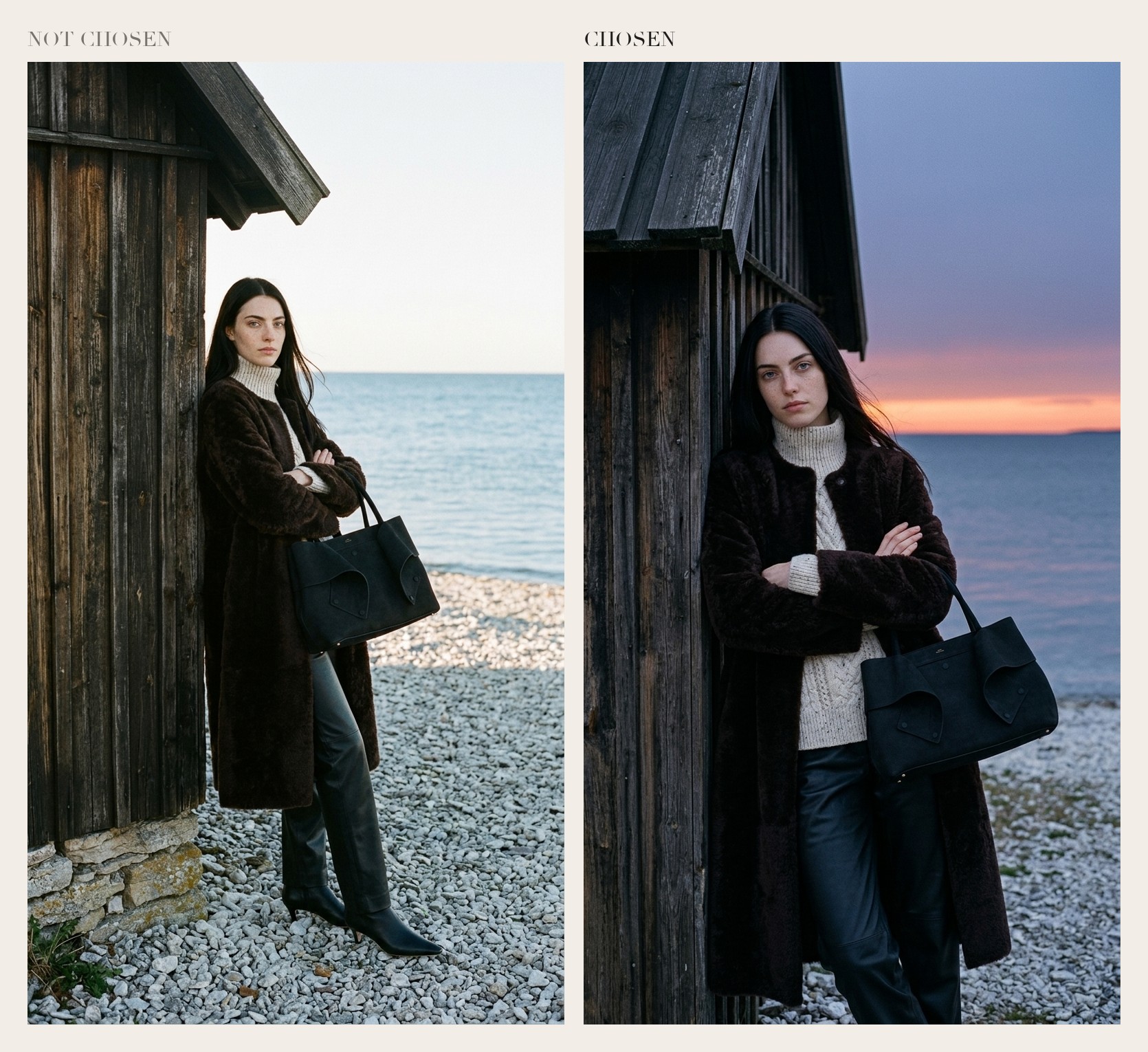
Sunset came out at noon. Eight pictures of her at the corner of a fishermen's hut, asked for in the setting sun, came back in flat daylight. The cause was my own line: almost every prompt described the film with the same "pale silver-blue sky", and repeated in prompt after prompt, that sky beat the hour. The redo got its own evening film line and the words "clearly evening, never daylight". The shot in the film is from that second set.
Firelight that looked like flash. The first pictures of her feeding the stove were lit flat and even, the whole room bright. I sent them back. The new prompt: only the open stove and one oil lamp, the far side of her face in shadow, nothing brightly lit, and flash on the list of things never to show.
Music nobody asked for. Every video prompt said "absolutely no music". Five of the 18 clips in the film came back with a score anyway. Those cuts borrow the sound of the cut before.
WHAT I CHANGED LATER
Since 1 November every prompt writes the light of its own hour and names the light source at night; flash only when a posed shot asks for it. Since 30 October an issue is one day in one outfit. And the woman on Fårö has a name now: Solveig, from Bergen, who records sound for documentaries.
WHAT THIS DAY TAUGHT ME
- Plan the day inside the real light. Here the plan's outline of the day began with a line about the sun, and every scene got the light of its own hour.
- Write the light for each hour, then look for the line that overrides it. The house style I had put in every prompt brought its own sky with it.
- At night, naming the light was not enough. The stove and the lamp were named, and the room still came back flat and bright. Only when I wrote the shadow on the far side of her face did it become firelight.
WHAT I DIRECTED
What I decided first was the balance. The film would lean toward fashion, with strong posed frames, and the magazine would be the day behind it, mostly unposed, its pictures made in their own shapes so the two would not look recycled.
I sent three scenes back: a pose at the stacks too close to the cover, a frontal at the church like a passport photo, and a lunch shot from directly above, which became a café table by the window. For the sheep by the stone wall I asked for eight frames from one camera position, like a strip of film: 32 pictures, eight kept.
In the edit I chose one score from sixteen made for the film and put every cut on its beat; the music drops away for the sheep, the dune and the fire, so the place can be heard. And I put the island's name on the cover in heavy letters: FÅRÖ. Later I wrote the rule: a place name leads the cover only when it is short and its letters are strong. Fårö was the example.
That is the job: not making the pictures, but knowing which ones the day needs — and, on Fårö, which hour each one belongs to.
— SACHIO KAWASAKI / FOUNDING EDITOR