Latitude · Maeve · November · 51.5° N London · How it was made
A line that draws itself, then walks
How I directed 51.5° N London — four pages that move, 307 stills, and what the day taught me.
Sachio Kawasaki, Founding Editor
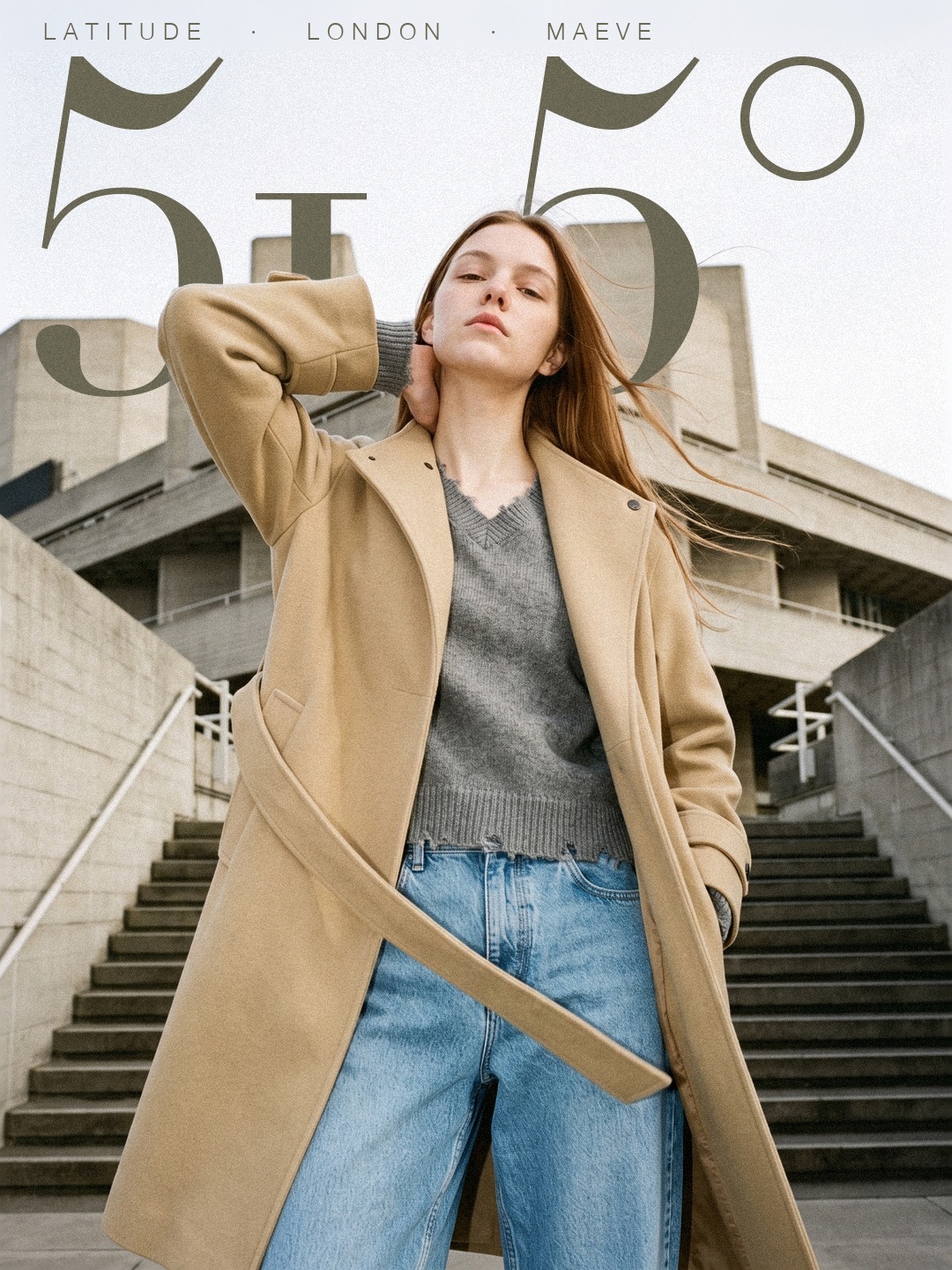
Nine minutes before it went live, I held it back. The London issue was due on the site at 10:00 on 22 October. At 09:51 I stopped it. When it went up at 12:19, three of its pages moved — on one, a figure draws itself in brush lines over a map of the Thames and, once finished, starts to walk.
LATITUDE is a series of fictional days filmed as if documented. Each issue is one day in one city, told in chapters by the clock. The crew is AI. I decide what is filmed and what stays.
London was my city for about seven years, as a fashion student. Here a young woman crosses it in one day: the concrete terraces of the National Theatre at 09:10, the brick highwalks of the Barbican at 12:30, the iron arches of Blackfriars Bridge at 16:40. Three outfits: a sand coat worn open over a grey V-neck and wide light jeans; a charcoal jacket over a striped camp-collar shirt and wine-brown pleated trousers; a long navy coat over a camel cardigan buttoned to the top and wide grey trousers.
HOW A PICTURE ARRIVES
Usually I decide what a picture shows. In London I also decided how it arrives on the page. The three pages that moved at 12:19:
- On a map of the Thames, a figure draws itself in a few thick brush lines — hair and profile, then the coat, the legs, the shoes — and, once finished, starts to walk in place.
- Around a photograph of her at the market, four strokes of oil paint in the issue's concrete grey are laid down one after another, as a frame.
- A brush-ink drawing of her at the Barbican hangs in an oak frame on a brick wall; only the drawing moves.
That evening a fourth followed: the issue's seven colours, painted on one at a time.
WHY THIS DAY
It began with a note on 19 October: overcast London, brutalist architecture. The same note kept the texture — infrastructure, concrete, grey sky, bare faces — and asked for it to be shot more architecturally, more like cinema. That gave the three places: the concrete of the National Theatre, the brick of the Barbican, the underside of a Thames bridge. On 20 October I had decided who travels: not one character but the camera, with whoever lives in each city. And the magazine ends on a photograph of a bridge at night because on 21 October I decided to drop the credits page and close on a picture that lingers.
WHAT IT TOOK
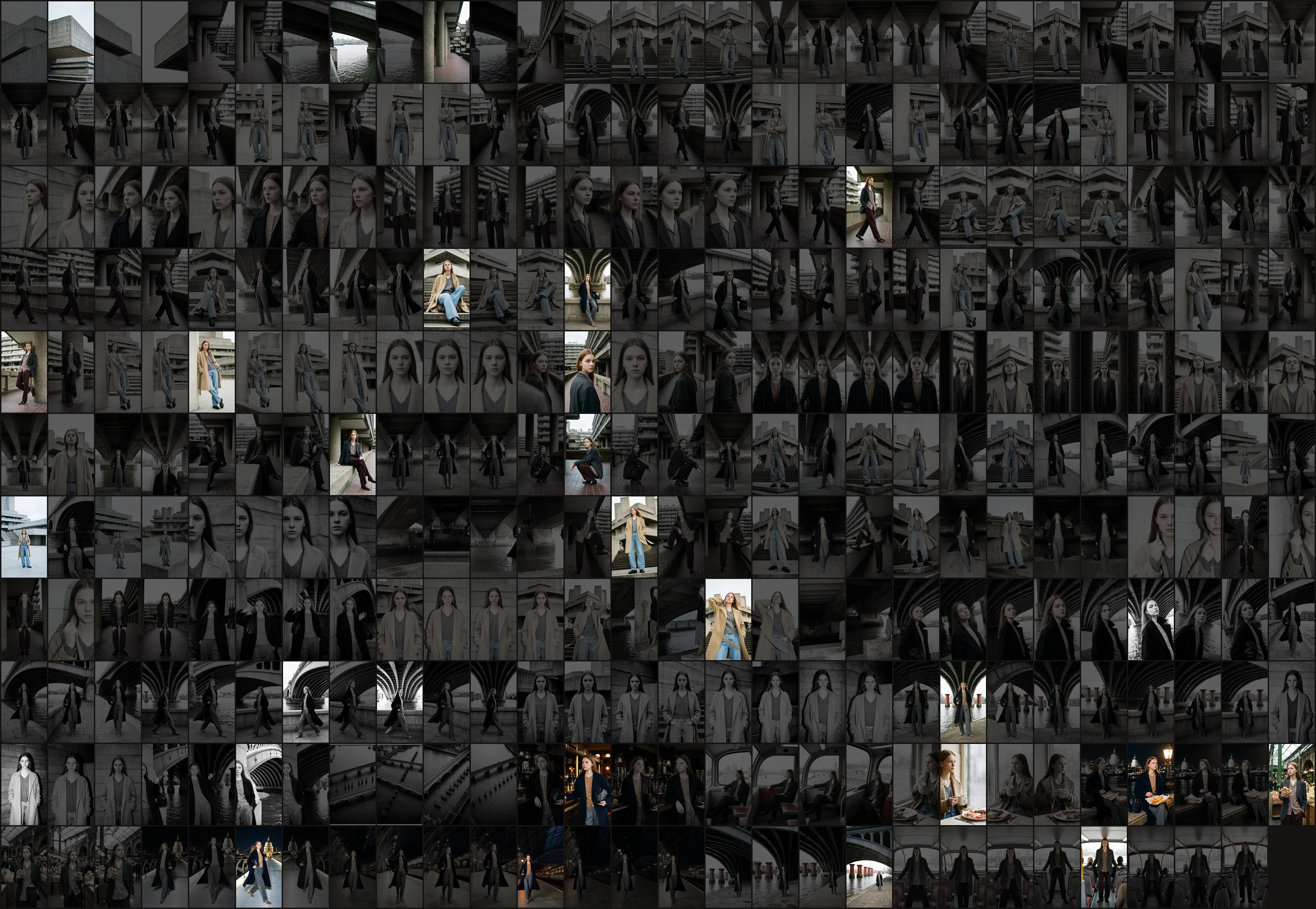
59 photographs of the real places from a public archive; 12 used. 307 still images. 28 video clips for the film; 12 are in it, with three stills of empty places. It runs 22.5 seconds and opens in black and white. 28 versions of the edit, from the evening of 19 October to the morning of the 22nd. The magazine grew from 10 pages on 21 October to 18 by the night of the 22nd.
28 of the 307 stills made it into the film and onto the pages.
WHAT WENT WRONG
The brush drew itself in. Asked for a drawing that makes itself, the video model painted in a brush doing the drawing. The next brief ruled out any tool, hand or shadow. Eleven minutes later the lines appeared on their own.
My paint looked like tubing. Simulated in code, the oil strokes came out even, like piped tubes. So the work was split: an image model painted the texture, and code revealed it stroke by stroke, in the order a brush moves.
A walk in four drawings. That evening I tried the same walk without video: four drawn frames, looped. Drawn as one sheet, the left and right legs came out the same; drawn one at a time, with one shoe black to tell the legs apart, it still stuttered. Smooth walking is what video is good at.
Lines nobody missed. On the site I added two things to tap: one drew back the railway bridge beside Blackfriars that came down in 1985; the other stacked a pulse up a Barbican column. Neither was interesting: a surprise needs a meaning. They came out the same night.
In the film, two shots at the bridge gave her a rounder face. On the morning of the 22nd I replaced them.
WHAT I CHANGED LATER
On 22 October I started a notebook: what each issue tried, what it kept, what it threw away. London is its first entry. Since 30 October an issue is one day in one outfit; London had three. And she has a name now: Maeve, 22, who works in a second-hand bookshop.
WHAT THIS DAY TAUGHT ME
- The picture was only half of it. How it arrives had to be designed too: the order, the speed, what starts it, what it lands on.
- Each tool did best at one job. Video for walking. The image model for the texture of paint. Code for order and timing.
- A surprise needs a meaning. The lines nobody would have missed came out that same night.
WHAT I DIRECTED
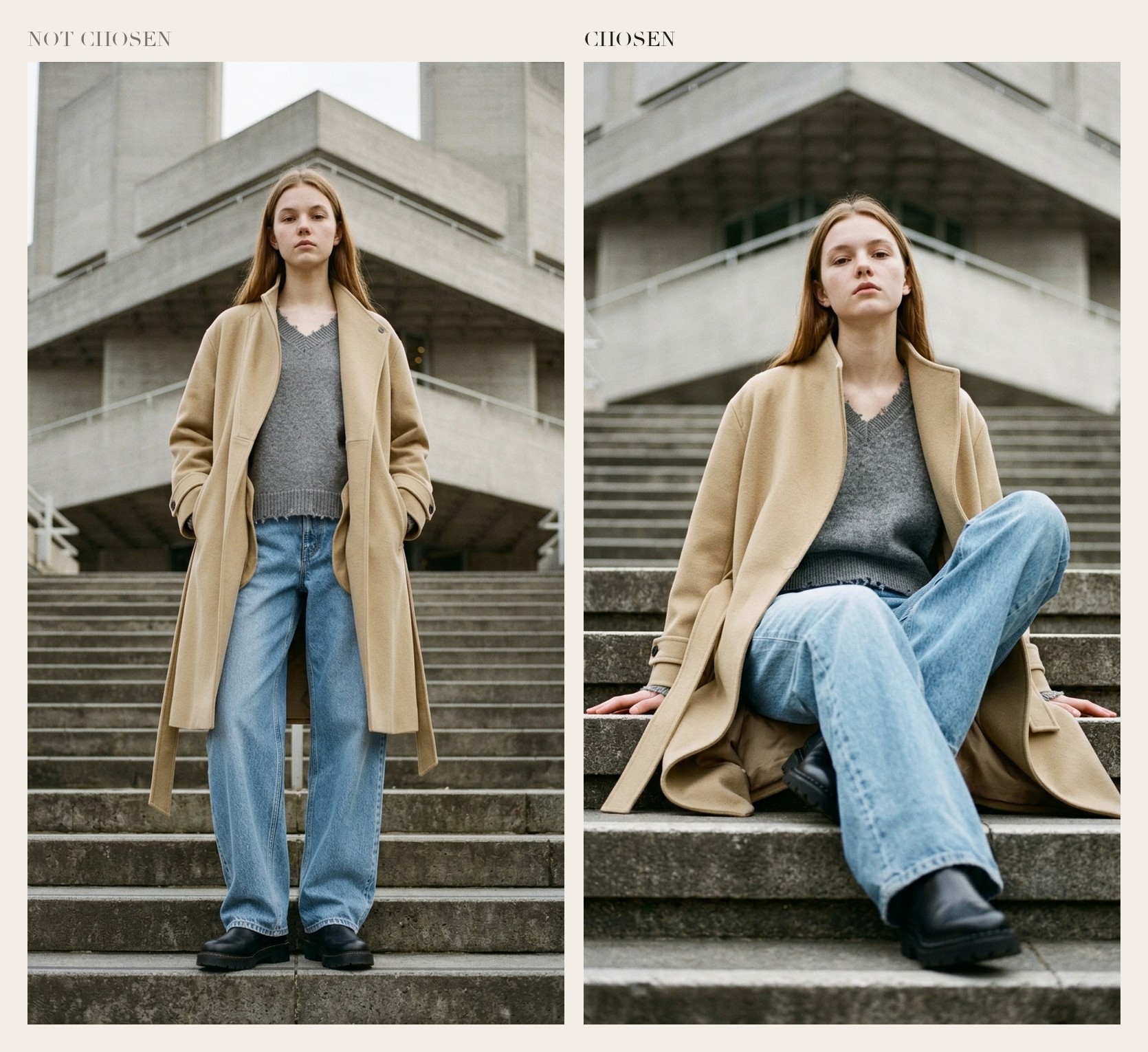
In the photographs, I dropped the first round — standing straight, facing the camera — and on 19 October reshot it sitting, leaning, looking up.
I asked for a figure in a few Matisse-like brush lines that draws itself and then walks, and placed that map near the front, as a guide to the day. I sketched where the four strokes should go around the market photograph, and set their colour to the concrete of the National Theatre. I asked for the tap-to-draw lines, and took them out.
One thing I kept from my own years there, on a Barbican page: Seven years a fashion student in London. Music for 18 Musicians at the Barbican. The pulse is still in these walls. The words stayed. The drawn pulse went.
That is the job: not making the pictures, but knowing which ones the day needs — and, in London, how each one should arrive.
— SACHIO KAWASAKI / FOUNDING EDITOR