Latitude · Maeve · November · 53.8° N Haworth · How it was made
A west wind, and one door
How I directed 53.8° N Haworth — a valley train, a wind that blows the same way in every frame, and one door to stop it.
Sachio Kawasaki, Founding Editor
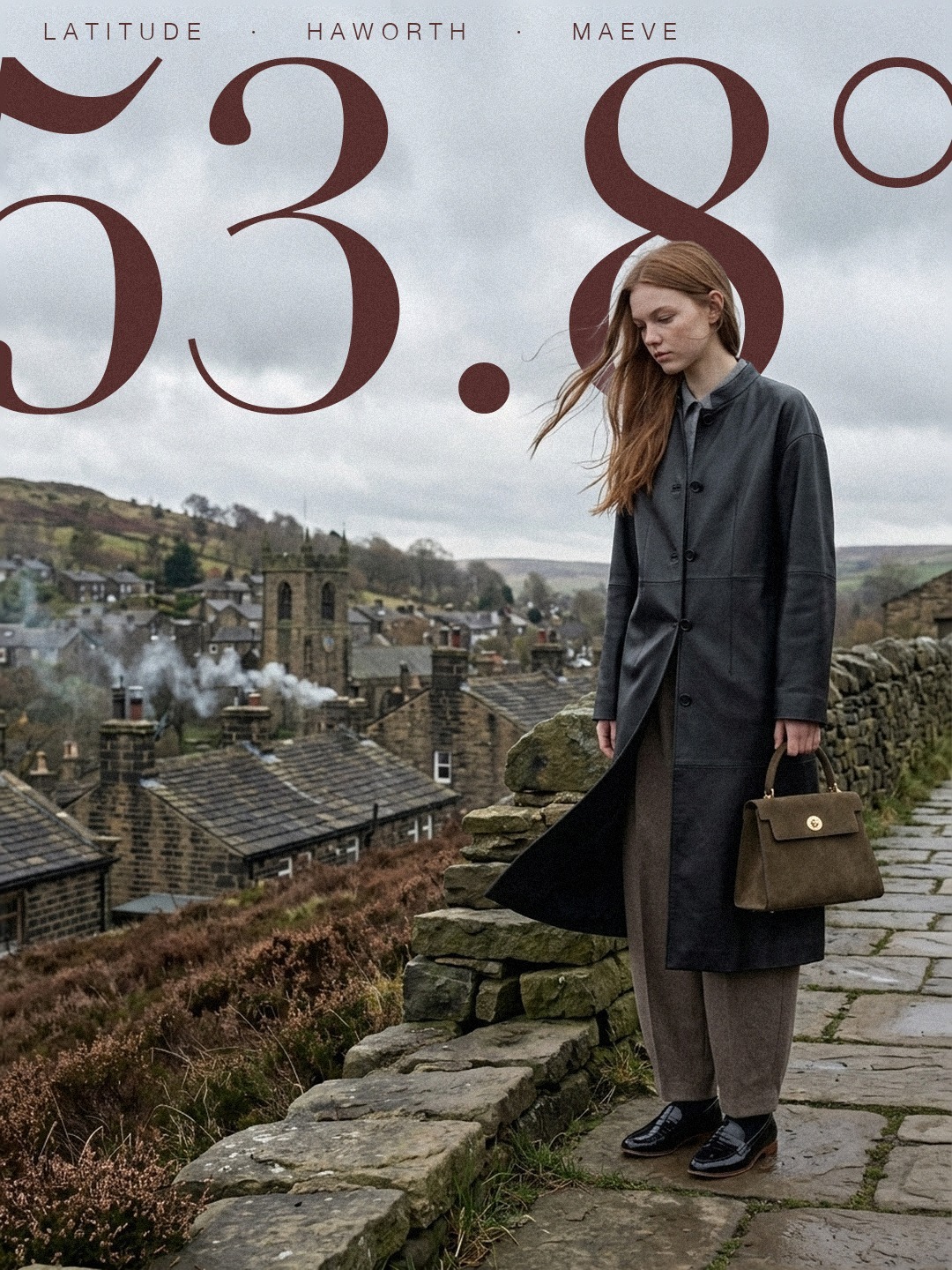
LATITUDE is a series of fictional days filmed as if documented. Each issue is one day in one city, told in chapters by the clock. The crew is AI. I decide what is filmed and what stays.
In Haworth, Maeve, who works in a second-hand bookshop in London, goes to a place she has met in a book. A Saturday in November: overcast, no rain, a strong west wind. One outfit, all day: a long black leather coat with a stand collar; a grey cashmere shirt; taupe flannel barrel trousers; black patent loafers with black socks; an olive-brown suede bag with one handle.
WHY THIS DAY
Maeve is someone who goes, by bus and slow train, to places she has met in books. Haworth, the village where the Brontë sisters wrote Wuthering Heights and Jane Eyre, answered that reason for travelling most directly. It can be reached from London by slow train, and from the station the hill, the churchyard, the parsonage, the moor and the inn join up into one road you can walk. A November moor would also make a day that looks and sounds nothing like the London issue before it. And I did not end on her shoes coming off in front of a fire: the Kanazawa and Vienna issues had both ended in that same way, with the day unwinding.
THE TRAIN
She comes by slow train. The last stretch is the branch line up the Worth valley from Keighley. It was closed in 1962. Volunteers reopened it in June 1968 and still run it.
The film begins on the platform; the magazine begins at 08:40, in the carriage: worn wine-red seats, varnished wood, steam at the glass. We picked the issue's six colours from our own photographs, in the order of the day, and the first was the red of those seats. We called it Moquette, after the fabric.
The train also gave us the wind. In the first shot, a gust tears the engine's steam to the left. Her coat is open. Within the hour it is buttoned to the collar, and it stays that way until the inn. From here on, hair, hem and heather all go the same way.
BEFORE ANY PICTURE
First I had AI write three separate days for Maeve: a lighthouse town in Cornwall, a harbour in sea fog, and Haworth. Compared with the authors hidden, the judges all chose Haworth, and so did I. From the harbour I took one scene: behind a wall, the wind lifting her book's pages, her palm pressing them flat.
Then I showed the rough storyboard to three AI models from three companies, revised it and showed it again, four times. Sixteen frames became twelve. The first version read like a lookbook, one walking or standing frame after another; the moment she passes through the inn door was never drawn; and the wind did little more than stir her hair. So I redrew the wind on her body: hair caught against her lips, the hem pressed to her legs, and inside the door, shoulders that had been raised all day coming down.
The idea: a body pushed by the wind all day goes quiet behind one door, and the wind stays only in her ears.
WHAT IT TOOK
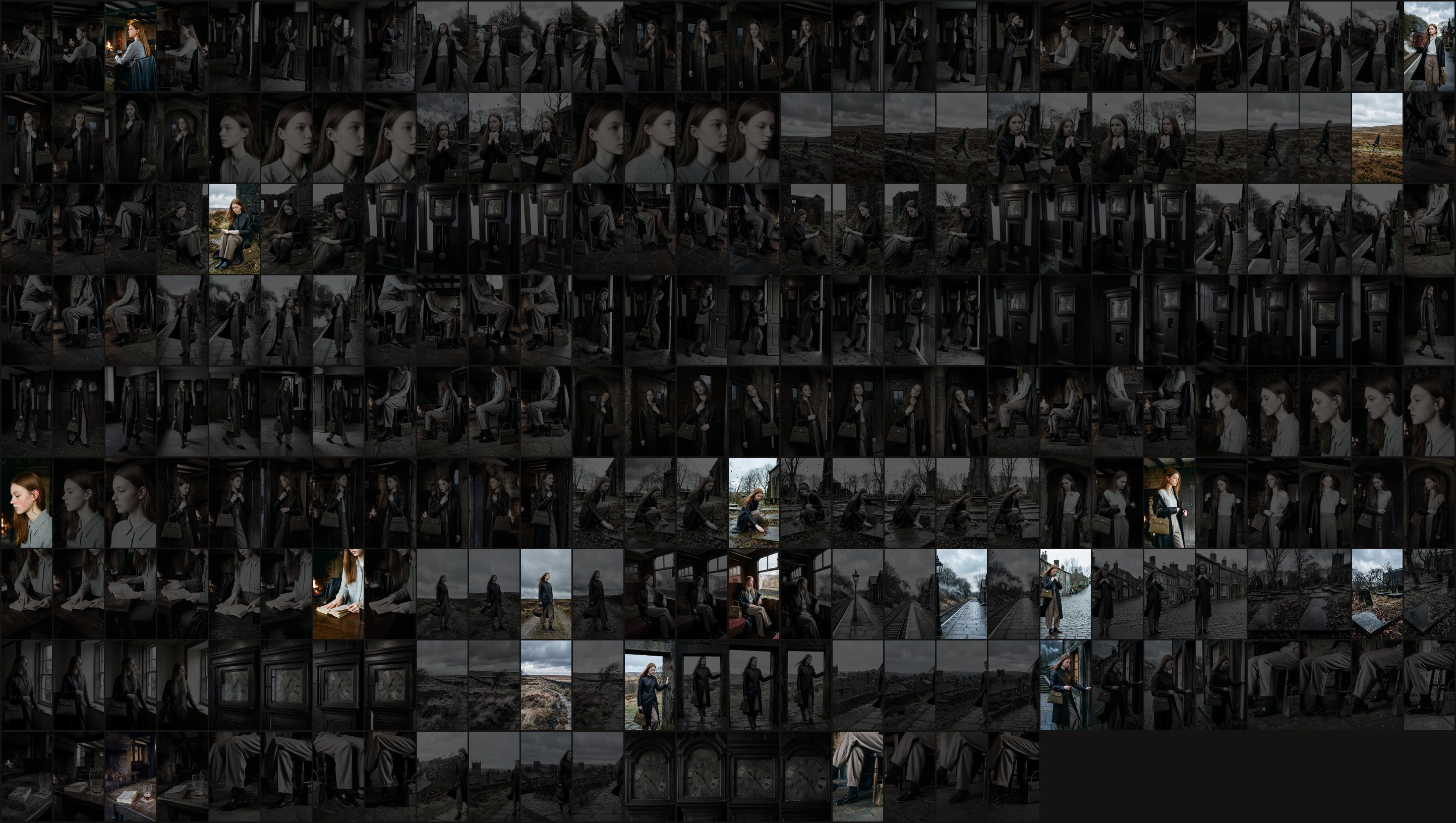
244 still images. 22 video clips. Four versions of the edit. A film of 24.5 seconds in eight shots, and a sixteen-page magazine.
WHAT WENT WRONG
Two doors. The plan had two silences: the Brontë parsonage at ten, where the wind drops to the tick of a clock, and the inn at four. Shown the stills in order, two critics said the same thing: once she has been indoors at ten, the inn is no longer the first quiet. I cut the parsonage, the scene that had first announced the idea.
A wet platform on a dry day. The best arrival picture had shining stone, a traffic cone and green leaves in November. Two small edits took out the cone, stripped the trees and dried the stone. Nothing else changed.
Four poses. Shown the film without being told what it was about, the critics stopped believing at four places: a runway walk, a bag shot, a lookbook, a product photograph. Before remaking anything, I moved closer — to the face, to the collar, to the hands and the page. The poses went out of the frame.
WHAT THIS DAY TAUGHT ME
- The wind, like the light, had to be decided first. All 26 still briefs carried the same sentence: the wind blows from screen right to left; hair, coat hem and heather stream left. With AI, nothing carries from one frame to the next unless you write it. When one moor photograph ran the other way, I flipped it.
- One turning point was enough for the day. Two good moments of the same kind weaken each other; cutting the parsonage showed me that.
- When a frame looked posed, moving closer was enough, before any remake. What made it a pose was usually the bag, or the whole figure.
WHAT I DIRECTED
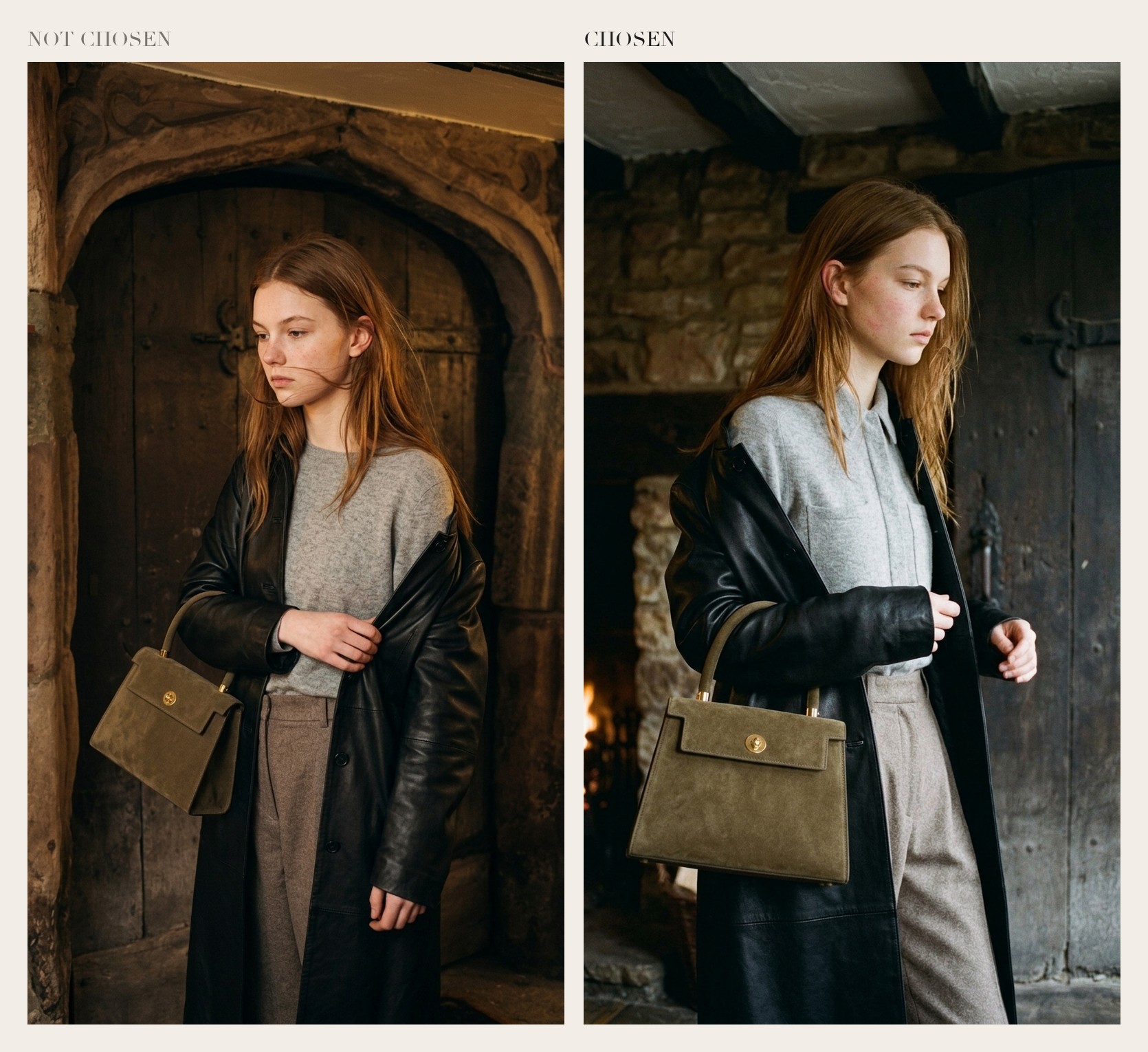
I listened to the critics; the decisions were mine. The wind blows one way all day, and one door stops it. The frame just inside that door I also chose myself, from candidates laid side by side.
In the churchyard I gave her hands something to do: crouch and brush wet leaves off a flat stone. The magazine shows the stone afterwards, half cleared, without her. I kept the sound that came with each clip, not the wind and door we had built. The film ends close on her ear, still red from the wind, as she tucks a strand of hair behind it.
Asked what they felt, and not told the aim, one critic wrote: you go somewhere warm, and the wind stays inside you. It was almost the sentence I had started with.
— SACHIO KAWASAKI / FOUNDING EDITOR