Latitude · Rin · November · 39.7° N Morioka · How it was made
Touching a winter town
How I directed 39.7° N Morioka — a day told through the hands, a salmon that showed too much, and what the day taught me.
Sachio Kawasaki, Founding Editor
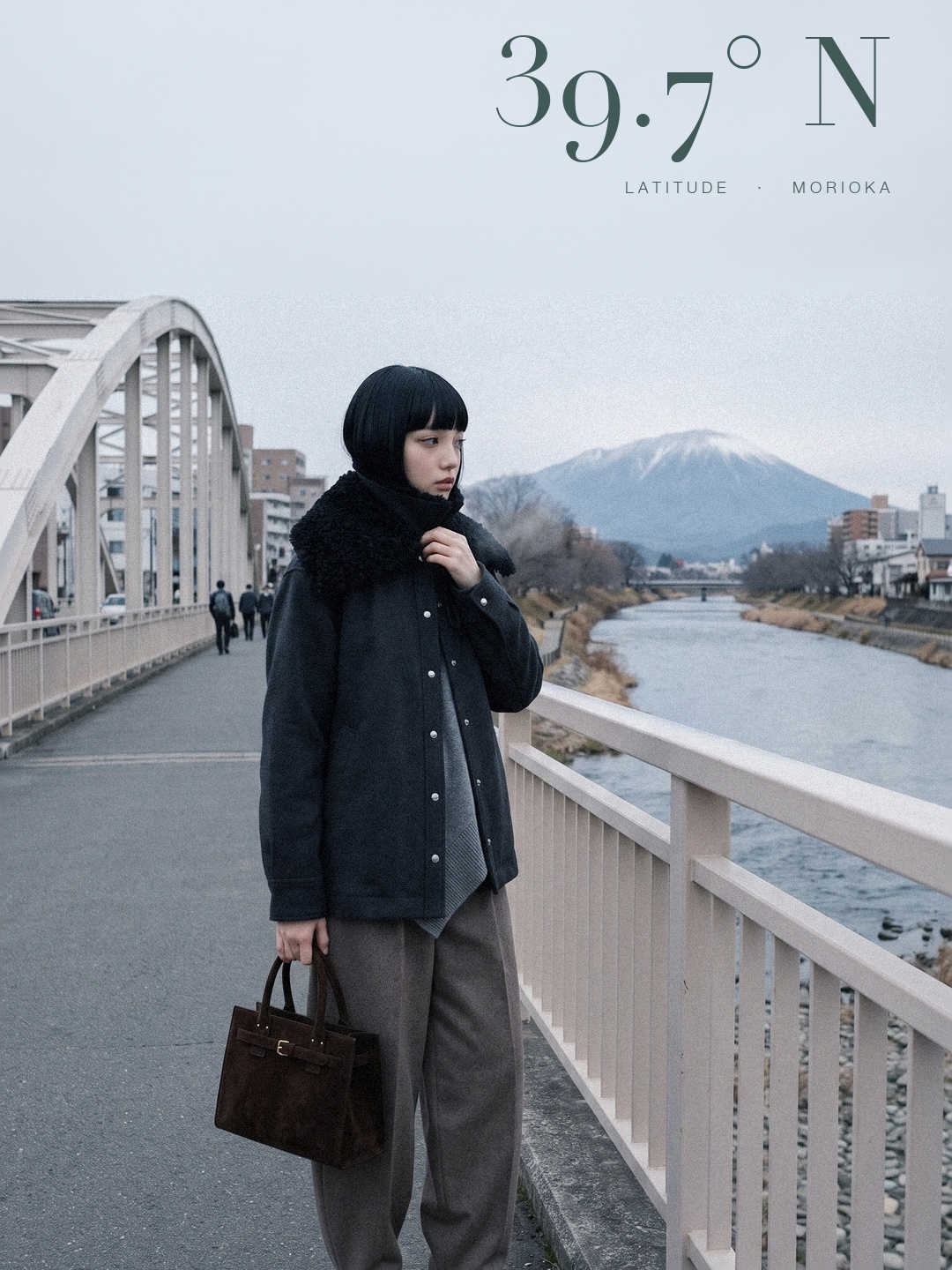
LATITUDE is a series of fictional days filmed as if documented. Each issue is one day in one city, told in chapters by the clock. The crew is AI. I decide what is filmed and what stays.
In Morioka, on 24 November, the day is overcast, dry and cold. Rin arrives on the morning Shinkansen and ends the day on the Kaminohashi bridge over the Nakatsu river. One outfit, all day: a dark charcoal wool shirt-jacket with a large black curly shearling collar; a grey knit whose hem falls to a point at one side; taupe flannel barrel trousers; black suede kitten-heel ankle boots; a dark brown suede satchel with two handles.
WHY THIS DAY
Rin works at a ceramics gallery in Tokyo. On her days off she travels to see the food you can only eat in one place and the things that are only made there. In Morioka, that means cast-iron kettles and jajamen noodles.
The story was chosen from three plans, compared with their authors hidden: a winter town, touched with the palms of the hands. Cold bronze in the morning, an iron kettle heavier than expected before noon, a hot cup held in both hands in the afternoon. Everyone has touched a freezing handrail by mistake, or lifted something heavier than it looked. The viewer can follow thirty seconds with the memory of their own hands, not a plot.
The day ends where the morning began, on the same bridge, at night. The first plan ended with a small iron cup she had bought, going lukewarm in her hand. Closing on a purchase read as a punchline, and it repeated Kanazawa, which ended sitting in a room. It went.
THREE TOUCHES, THREE SHAPES
The first storyboard had sixteen frames. The first thing a critic said was that it looked like a tour of Morioka's sights: the train, the volcano, the salmon, the ironware, the noodles, the coffee shop, the castle walls. Every frame said "Morioka has this" before it said what Rin was doing there.
The second note: every touch had the same shape. Medium distance, a hand placed on an object, eyes on the hand. Three times the same shape, and by the second you know what is coming.
The storyboard was drawn three times, and sixteen frames became twelve, then ten. Each touch now has its own distance and its own movement.
- 08:53, the Kaminohashi bridge. Chest and hand. Her hand had been resting on the bronze finial while she leaned to look at the river; the cold lifts it slightly. She does not look at it.
- 10:45, the ironware shop. From the side, waist up. She lifts a kettle two or three centimetres off a low table, and her wrist sinks a little.
- 15:00, a coffee shop window. Face and both hands. She wraps her palms around a cup still on the table, breathes out once, her shoulders drop, and she stays like that for about two seconds.
The hands were never to be arranged for the camera. Fingers held together and floating, a kettle raised to chest height: those turn a moment into a product demonstration.
WHAT IT TOOK
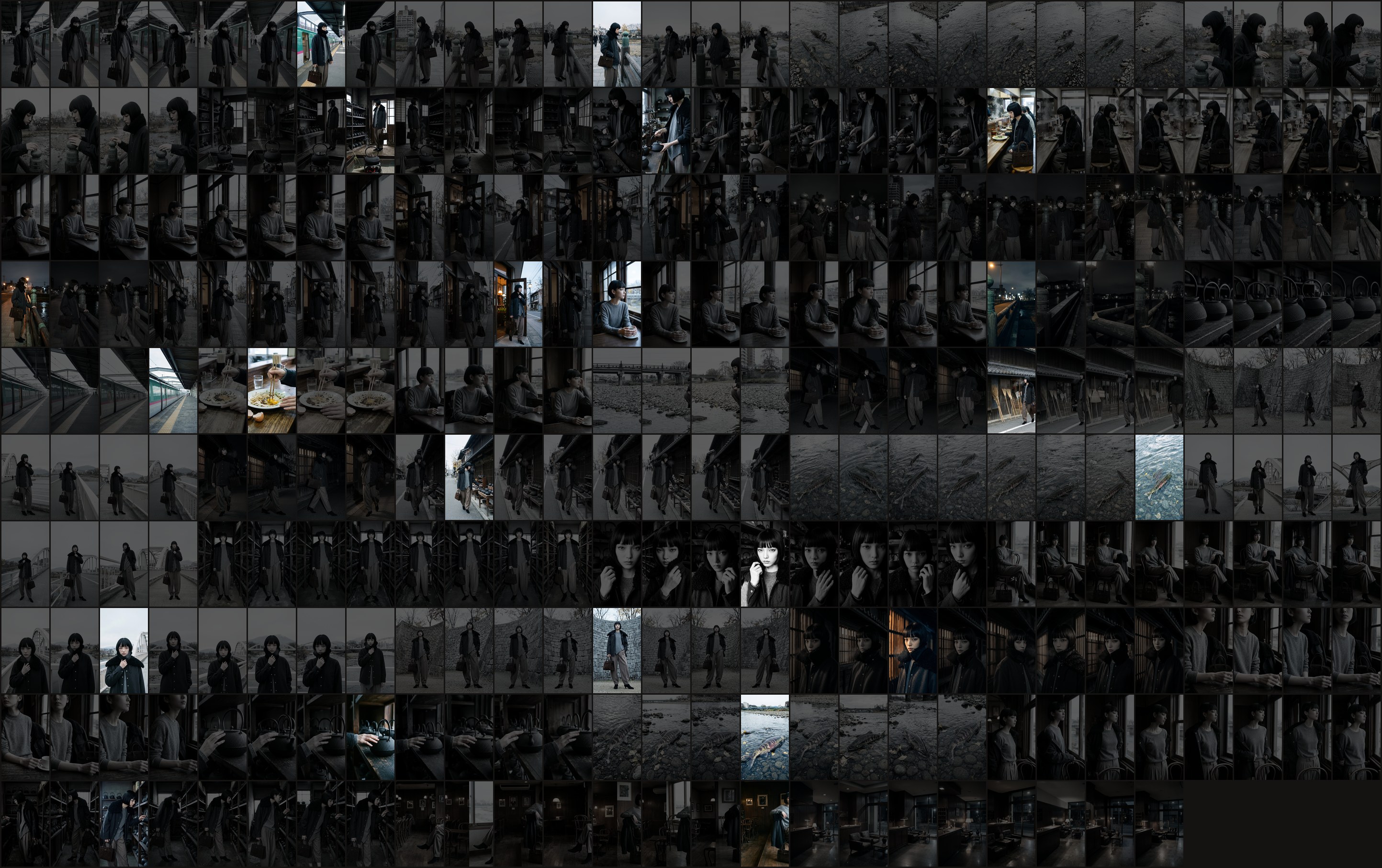
164 stills: 120 for the film and 44 for the pages, eight per shot to choose from. Laid side by side, the chosen frames had problems: at night on the bridge she was lit flat from the front like a B movie, and at the coffee shop door she stood in a pose. The coffee shop, the door and the night bridge were each made again, eight more stills each.
32 video clips, six exports. According to the files, everything from the storyboard to the sixth export happened on 1 November. I finished the film myself in Final Cut on 7 November: ten cuts, 26 seconds. The carousel has fourteen pages, and every photograph in it is new, made to the shape of its page, of the moments the film skips.
SHOWN BLIND
I showed the finished cut to three AI models without telling them what it was meant to do. All three came back with a cold body slowly warming, and with time spent alone. Two of them named touching outright.
Two moments broke the spell. All three saw a pose in Rin stopping outside the coffee shop door; I had that clip remade so she steps down and keeps walking. Two saw a product demonstration in the way she held the kettle; that clip was remade too, and only the stretch where the weight settles into her wrist is used.
WHAT WENT WRONG
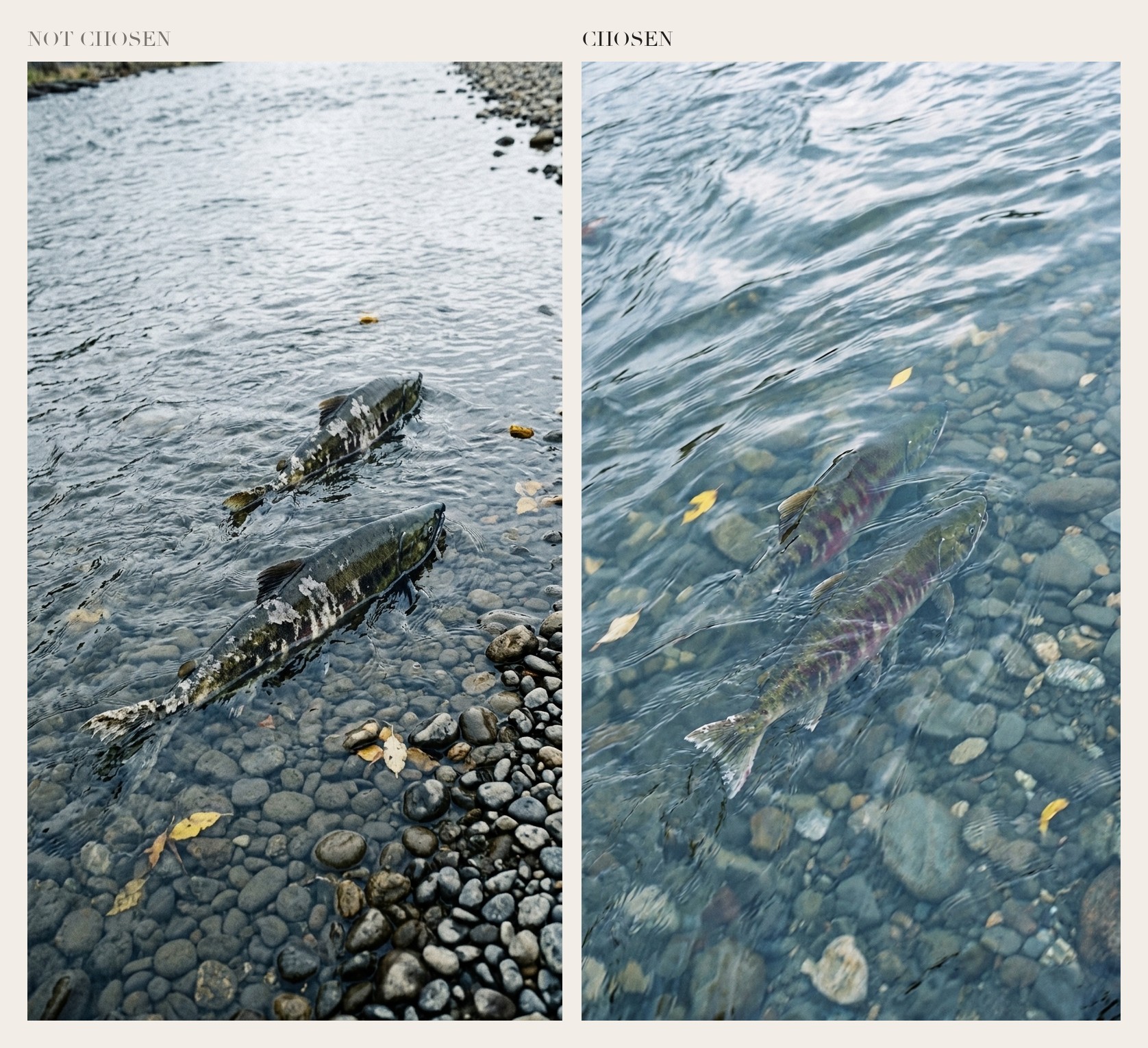
A salmon that showed too much. In the first storyboard the salmon was a glossy, healthy fish, any river's fish. A critic pointed out that a salmon that has swum two hundred kilometres upriver has frayed fins and a body flaking white, and holds still in the current. Made that way, it became a white, peeling salmon in the shallows with its back out of the water. True to fact. On screen, it showed too much. I had it remade: two fish holding in the middle of the current, under the water, worn only at the tips of the fins.
Steam from the floor. In the ironware shop, the steam rose from the sand on the floor instead of from the kettle's spout. A retouch gave it one thread of steam from the spout.
A street lamp as a halo. On the bridge at night, a lamp sat directly behind her head. Only the lamp was moved aside.
FROM STORYBOARD TO FILM
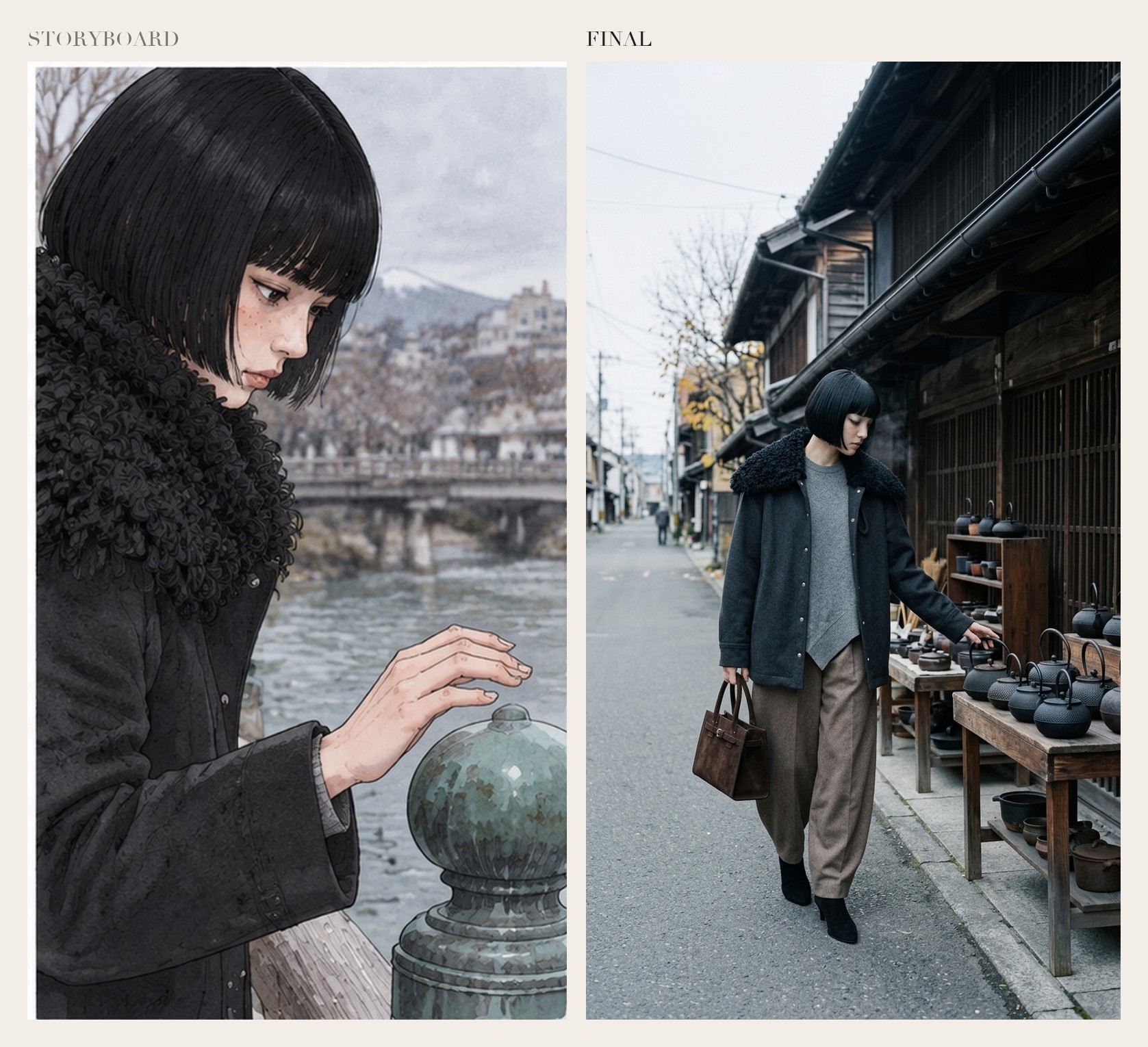
Before the sixth export I cut the finial shot. Her hand looked as if it were touching the finial with great care, almost nervously. It is only an ornament on a bridge; nobody touches one that carefully. If you touched it at all you would do it in passing, and the touch did not seem to matter enough to give it a shot of its own. In its place: 10:30, a street in Konyacho lined with ironware shops, and her fingertips brushing the handle of a kettle on a shop front as she walks past. The first touch is no longer cold bronze but an iron kettle in passing, and it leads straight into the shop where she feels a kettle's weight. The jajamen shot stayed.
NOVEMBER 7
LATITUDE's documentary issues are finished with the sound of the place only. Morioka has one piece of music. The story is a quiet one, and I wanted it to hold together. I wanted the whole thing to settle into a feeling of quiet relief, so I chose something soft that stays out of the way — music that lets you feel a little wistful.
The opening "39.7° N" first sat at the top left, where the white letters were hard to read against the bright sky and the bones of a roof. I asked for a place where white letters could be read, and it moved to the top right, over a dark roof. The reel cover became the kettle shop front in Konyacho, a different picture from the carousel cover on the Kaiun bridge, with the latitude in the same place and at the same size on both.
8 NOVEMBER: THE CAROUSEL, REBUILT
The day after it went up, I went back through the carousel and felt that nothing stayed with me once I reached the end. The only thing that did was the drawing of the walk back. Of its fourteen pages, four were full-length pictures of Rin in the black jacket, seen from a little way off, and the page of numbers read like a tourist leaflet. Neither the touch of the clothes nor the eye of the person wearing them came through.
What I set out to change was not the number of pages but whether turning them felt worth it. I allowed myself up to twenty, and each time I laid it out I asked three AI readers whether it was worth looking at and what was missing.
What went in:
- Strong fashion pictures. The cover became a close portrait on the Kaiun bridge, white breath and the curly collar. A full-length figure against the castle walls. A profile leaning in to a kettle in the ironware shop. A black-and-white close-up, as if shot on a Nikon FM2 with Tri-X. A close portrait in the lattice light at night.
- A page of four details: the collar, the hem, the bag, the boots.
- Two lines in Rin's own words. In the kettle shop: "The kettles were heavier than I thought, and cold." In the evening: "By five the river had turned the colour of the kettles." At first the kettle-shop line was "At the gallery we ask people not to touch. Here I touched every kettle." I meant it as something only someone who works at a ceramics gallery would say, but reading it back, it needed explaining. I replaced it with a line about what the hand remembered: the weight and the cold.
- The riverbed spread became a watercolour. Where Rin looks down into the water, the photograph of the salmon lies on the page like a print.
- The coffee shop was remade as one wide picture across two pages: the room on the left, Rin seated on the right.
- The map now moves: a dotted line follows the streets and, at each stop, a round photograph of the place appears.
What came out: the page of numbers, the night walk, and Rin at the window with her cheek on her hand. The window picture was the same moment as the film.
Sometimes the AI readers and I disagreed. To the end they asked me to change the black-and-white close-up with her hand at the collar, to change the seated portrait in the coffee shop, and to drop the drawing. I had asked for the black-and-white picture as the strong one in the kettle shop, and I had decided that the coffee-shop page should be a fashion picture. The drawing was the one thing that stayed with me in the fourteen-page version. All three stayed.
What went wrong was the neck. I was told again and again that the issue lacked a quiet sensuality, so I made a picture of Rin letting her jacket slip from her shoulders in the coffee shop. It was a beautiful picture, and when I looked closer the knit had become a different knit, with a wide open neckline. The real one has a close crew neck. Changing the clothes to show the neck would break the work. It went. The window picture I brought back had a different, round bag on the chair, so I removed the bag. In the noodle picture, I removed only the eggshells beside the plate; the egg is still being stirred in.
The rebuild added 112 stills, 276 in all. At the end I put an eighteen-page and a twenty-page version side by side. All three AI readers chose the eighteen pages. I preferred the twenty. I finished from the twenty-page version, putting the watercolour and the salmon into one spread and the six colours and the drawing onto one page, at eighteen pages.
WHAT THIS DAY TAUGHT ME
- A feeling shown three times needs three shapes. The same distance and the same hand told the viewer what was next by the second time. Changing the distance and the order of the movement made it three steps.
- A picture true to fact is not always a picture you can watch. The worn salmon was the real thing, and on screen it was too much. The fact of the place went in, in a form the viewer could take.
- Standing still reads as a pose. Stopped outside the door, Rin looked posed to all three viewers. Cut in the middle of a step, the clothes went back into the day of the person wearing them.
- What makes pages worth turning is not the number of pictures but the eye of the person in them. Her two lines and a hand on cold iron made the carousel, for the first time, this person's day. But a line has to work without explanation; the one that needed explaining went.
- Do not change the clothes for sensuality. The picture that showed the neck was wearing a different knit. Look for it in the profile, the hands and the light, with the clothes as they are.
WHAT I DIRECTED
I decided the salmon showed too much. I cut the finial shot and added the walk through Konyacho. I kept the noodles. I added the music. I finished the edit myself in Final Cut, moved the latitude where the white letters could be read, and changed the reel cover to the kettle shop. The next day I rebuilt the carousel at eighteen pages. I kept the black-and-white close-up, the seated coffee-shop portrait and the drawing when the AI readers asked me to change them, and threw out the picture of the neck because the clothes were not the clothes.
AI can make a picture that is true to the facts. Deciding that it shows too much is still the job.
— SACHIO KAWASAKI / FOUNDING EDITOR